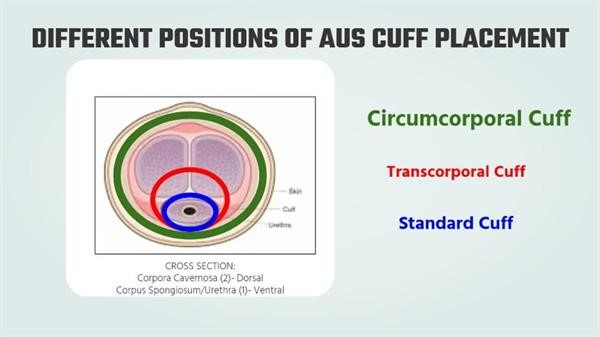
MP71-01: CIRCUMCORPORAL ARTIFICIAL URINARY SPHINCTER (CC-AUS): A NOVEL SURGICAL APPROACH FOR THE TREATMENT OF COMPLEX MALE STRESS URINARY INCONTINENCE (SUI)
Introduction: The CIRCUMCORPORAL AUS (CC-AUS) is an innovative approach for patients with compromised urethras previously not candidates for replacement of an AUS. Men who have had prior AUS erosions, with simultaneously compromised corpora cavernosa, may no longer be suitable candidates for available techniques, such as the transcorporal AUS (TC-AUS). This is a single surgeon (JB) review of the outcomes of the CIRCUMCORPORAL-AUS where the cuff is placed around all three corporal bodies. Methods: This is a retrospective study on a database of AUS surgical outcomes. From 2000 to present, 611 AUS procedures were performed. Of these, 12 CC-AUS procedures were performed between Feb 2016 and Nov 2022. 10 have had sufficient follow up after AUS activation and are included in the analysis. Of the 7 patients with prostate cancer, all had radiation therapy (XRT). 5 had a radical prostatectomy with adjuvant XRT, 1 had EBRT alone and 1 had XRT with salvage cryoablation. One patient had a traumatic pelvic fracture with a bladder neck injury. The average cuff size was 8.98 cm. Patients were surveyed pre- and post-operatively and scored the severity of their incontinence in pads/day, improvement vs pre-op SUI, comparison to their first AUS and if they would have the surgery again. Outcomes were analyzed using 2 tailed T-test. Results: Mean follow up is 2.5 years (1.3 to 6.5 years). There was a decrease from 9.9 to 3.34 pads/day (p= 0.002). 100% of patients noted SUI improvement from pre-op (prior to CC-AUS). When compared to the first AUS, 44% felt they were “more dry”, 11% were similar and 44% felt “less dry”. All patients would have surgery again or would recommend to a friend. No patients reported urinary retention, change in penile sensation, glans necrosis, infections, or AUS malfunction. 2 patients required downsizing of their cuffs, and both had improvement. One patient had an erosion (ventral) of his CC-AUS with removal. Conclusions: This is the first report of the CIRCUMCORPORAL AUS. It appears to be a safe and effective surgical option for SUI in complex cases with prior AUS erosions. It has been successful in patients following XRT and multiple prior erosions. There have been no sensory or penile vascular changes noted. Longer term follow up is required to determine if results are durable. SOURCE OF Funding: N/A