Associate Professor Department of Nephro-urology, Nagoya City University Graduate School of Medical Sciences
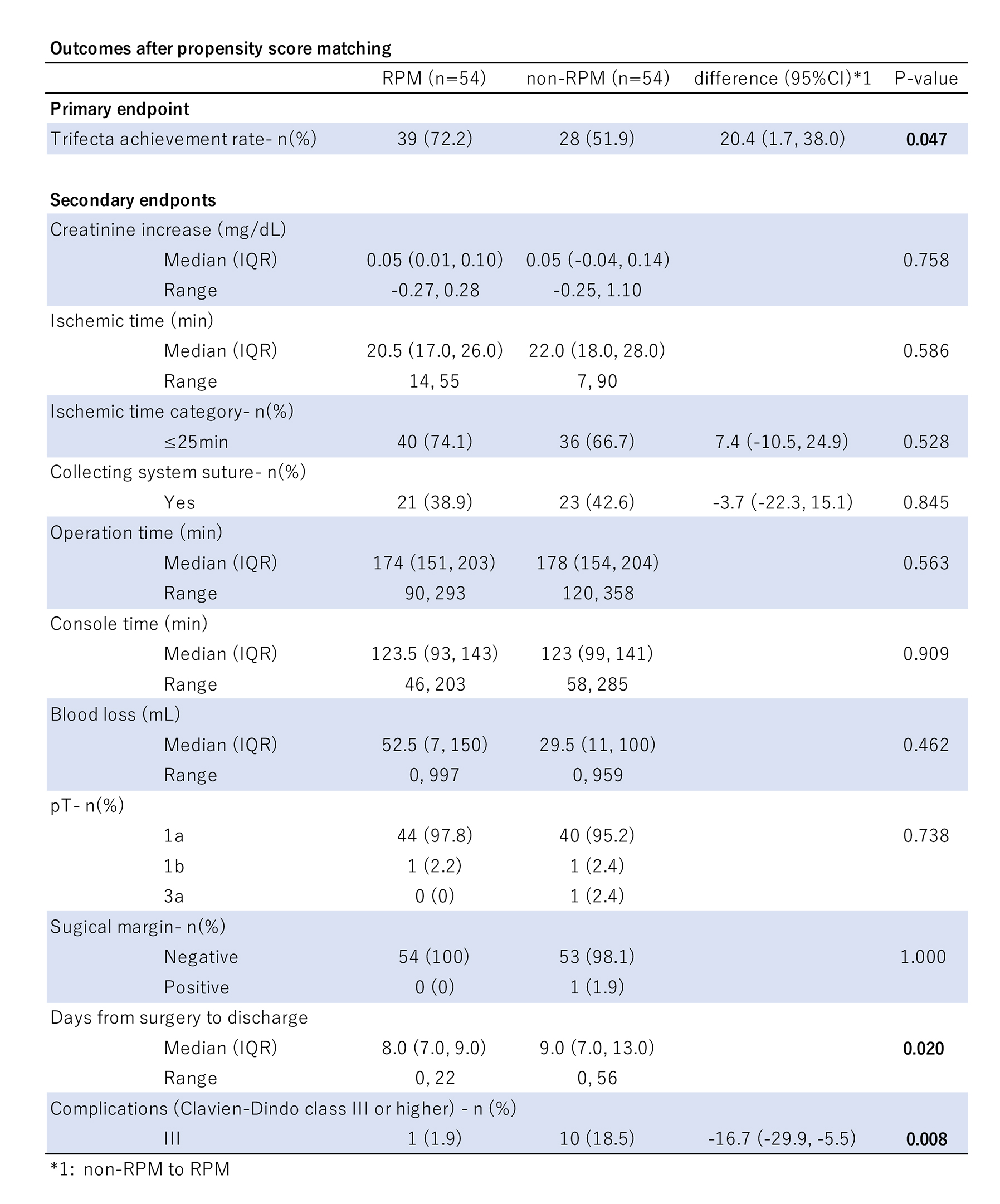
Introduction: The Aim of this study was to examine the effect of preoperative 3DCT-based tumor resection simulation, Resection Process Map (RPM) on the outcome and complications of Robot-Assisted Partial Nephrectomy (RAPN). Methods: We retrospectively analyzed 180 patients aged 20 years or older (RPM group; n=100 and non-RPM group; n=80) who underwent RAPN for renal tumors between November 2012 and February 2022. DICOM files of contrast-enhanced CT images were loaded into the medical imaging workstation Ziostation® 2 to construct an RPM. Based on the 3D structure of the arrangement and shape of the vessels and collecting system exposed on the resected surface by removing the "tumor section with a 5 mm-thick renal parenchymal resection margin" on 3D-CT. Outcome analyzes were performed on cases selected by propensity score matching. The primary endpoint was the achievement rate of trifecta ((1) negative resection margins, (2) warm ischemic time (WIT) within 25 minutes, and (3) no perioperative complications), and the Secondary endpoints were intraoperative and postoperative factors (renal function, intraoperative information, surgery-related time, blood loss, pathology, length of hospital stay, and complications). Summary statistics were calculated with and without RPM and compared using Wilcoxon's rank sum test for metric and ordinal data and Fisher's exact probability for nominal scale data. Results: As a result of propensity score matching, 108 cases (RPM; n=54, non-RPM; n=54) were extracted after adjustment for patient and tumor characteristics, experience of operators and assistants, etc. The achievement rate of trifecta as the primary endpoint showed significantly higher in the RPM group (72.2%) than in the non-RPM group (51.9%) (p=0.047) The results of the secondary endpoints showed that the RPM group had fewer complications of Grade III or higher (RPM 1.9% vs non-RPM 18.5%, p=0.008) and shorter postoperative hospital stay (RPM 7.0 days vs non-RPM 8.0 days, p=0.020). Conclusions: It was suggested that RPM in preoperative 3D-CT of RAPN may not only contribute to the achievement of trifecta but also suppress the occurrence of serious complications by giving the operator detailed information on tumor resection. SOURCE OF Funding: Japanese Society of Endourology Grant