
.png)
Other

Karen Lapham, DDS
PGY-2
UT HEALTH SAN ANTONIO
University of Texas Health Science Center, San Antonio
Lackland AFB, Texas, United States
Maria Becerra Garcia, DDS
UT HEALTH SAN ANTONIO
Jayakumar Jayaraman, BDS, MDS, MS, PhD
VCU School of Dentistry Department of Pediatric Dentistry

Kevin J. Donly, DDS, MS
Professor and Chair
University of Texas - San Antonio
San Antonio, Texas, United States
Jon Gelfond, MD, PhD, MBA
UT HEALTH SAN ANTONIO
Cristina Leon Pineda, DMD, MPH, MSDS
University of Colorado
Aurora, Colorado, United States
Maria Jose Cervantes Mendez, DDS, MS
Program Director
University of Texas Health San Antonio
San Antonio, Texas, United States
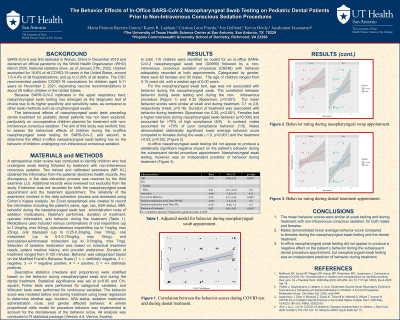
Purpose: The aim of this study was to assess the behavioral effects of children during the in-office nasopharyngeal swab test for SARS-CoV-2 and to determine the effect of in-office nasopharyngeal swab test on the behavior for dental treatment with oral conscious sedation.
Methods: A cross-sectional chart review was conducted to identify children who had undergone swab testing followed by dental treatment with conscious sedation. Chi-square, Fisher tests and Wilcoxon tests were performed to analyze the effect of swab on dental treatment. Linear regression was conducted to determine whether age, duration, ASA status, and OCS medication, and gender affected behavior. Statistical significance was set at P < .05.
Results: In total, 110 children (60 females and 50 males) were included in this study. The mean behavior scores were similar at swab and during treatment with oral conscious sedation, for both males and females (P=.16). Males demonstrated lower average behavior score compared to females during the nasopharyngeal swab (P < .01) and the dental treatment (P < .02). In-office nasopharyngeal swab testing did not appear to produce a negative effect on the patient’s behavior during the subsequent dental procedure appointment, although nasopharyngeal swab behavior was an independent predictor of behavior during treatment (P < .02).
Conclusions: The mean behavior scores were similar at swab and during treatment with oral conscious sedation, for both males and females. Males demonstrated lower average behavior score compared to females during the nasopharyngeal swab and the dental treatment.