
.png)
Pulp Therapy


Amy Engel, DDS
Resident
University of Southern California
University of Southern California
Los Angeles, California, United States
Talar Mardouryan, Student
University of Southern California
Candice Shahandeh-Rad, Student
University of Southern California
Catherine Pham, DDS
925 W 34th St
Los Angeles, California, United States
Alexander Alcaraz, DMD
Program Director
Herman Ostrow School of Dentistry of USC, Los Angeles, CA
Los Angeles, California, United States
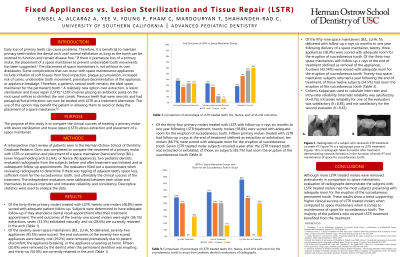
Purpose: The purpose of this study is to compare the clinical success of treating a primary molar with lesion sterilization and tissue repair (LSTR) or extraction and placement of a space maintainer.
Methods: A retrospective chart review of patients seen in the Herman Ostrow School of Dentistry Graduate Pediatric Clinic was completed to compare the treatment of a primary molar with LSTR or extraction and placement of a space maintainer [band and loop (B/L), lower lingual holding arch (LLHA), or Nance (N) appliance]. Two pediatric dentists evaluated radiographs from the subjects to determine if space was maintained in the arch, and ultimately the clinical success of the treatment.
Results: Of 43 primary molars treated with LSTR, 21 molars (48.8%) were scored with adequate patient follow-up. The end outcomes of the 21 scored molars were 8 (38.1%) extracted, 7 (33.3%) exfoliated naturally, and 6 (28.6%) are currently retained in the arch. Of the 77 space maintainers (B/L, LLHA, N) delivered, 72 appliances (93.5%) were scored. The end outcomes of the 72 scored appliances were 23 (31.9%) were removed prematurely due to patient discomfort, the appliance breaking, or the appliance unseating at home. Fourteen (19.4%) were removed by the dentist when the permanent dentition was erupting, and 35 (48.6%) are currently retained in the arch. Results from the pediatric dentists’ evaluations are pending.
Conclusions: These results show a trend supporting the higher clinical success of space maintainers when compared to LSTR treated molars.