
.png)
Special Health Care Needs

Creighton Powell, DDS
Pediatric Dental Resident
Children’s Hospital of Pittsburgh of UPMC, Pittsburgh, PA
Children's Hospital of Pittsburgh
PIttsburgh, Pennsylvania, United States
Creighton Powell, DDS
Pediatric Dental Resident
Children’s Hospital of Pittsburgh of UPMC, Pittsburgh, PA
Children's Hospital of Pittsburgh
PIttsburgh, Pennsylvania, United States
Mary Chapman, DDS
Research Mentor
Children's Hospital of Pittsburgh
Pittsburgh, Pennsylvania, United States
Mary Chapman, DDS
Research Mentor
Children's Hospital of Pittsburgh
Pittsburgh, Pennsylvania, United States
Heather Baumhardt, DDS
Program Director
Children's Hospital of Pittsburgh
PIttsburgh, Pennsylvania, United States
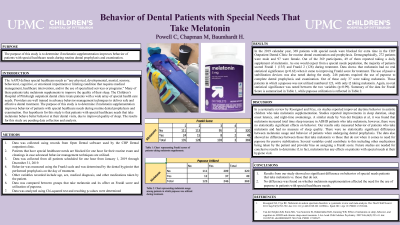
The AAPD defines special healthcare needs as “any physical, developmental, mental, sensory, behavioral, cognitive, or emotional impairment or limiting condition that requires medical management, healthcare intervention, and/or the use of specialized services or programs.” Many of these patients take melatonin supplements to improve the quality of their sleep. The UPMC Children’s Hospital of Pittsburgh outpatient dental clinic treats patients with a wide array of special health care needs. Providers are well trained in advance behavior management techniques to deliver safe and effective dental treatment. The purpose of this study is to determine if melatonin supplementation improves the behavior of patients with special healthcare needs during routine dental prophylaxis and examination. Data was collected using records from Open Dental software used by the CHP Dental outpatient clinic. Patients that have special healthcare needs are blocked for one hour for their routine exam and cleanings in case advanced behavior management techniques are utilized. Data was collected from all patients scheduled for one hour during the 2019 calendar year. Behavior was measured using the Frankl scale and was determined by the dental hygienist that performed prophylaxis on the day of treatment. Other variables recorded include age, sex, medical diagnosis, and other medications taken by the patient. Our hypothesis for this study is that patients with special healthcare needs taking melatonin have improved quality of sleep and, therefore, better behavior in the dental chair. The results for this study are pending data collection and analysis.