
.png)
Sedation


Brigid Daly, DDS
PGY-2
University at Buffalo/Women and Children’s Hospital of Buffalo, Buffalo, NY
University at Buffalo
BUFFALO, New York, United States
Allana Langen, Bachelor's of Science, Sociology and English
University Pediatric Dentistry

Ayah Koleilat, DDS
Resident
University at Buffalo/Women and Children’s Hospital of Buffalo, Buffalo, NY
University at Buffalo School of Dental Medicine
Amherst, New York, United States
Jonathan Malinovsky, BS
University Pediatric Dentistry
Christopher Heard, MD
Attending Anesthesiologist
University at Buffalo
Buffalo, New York, United States
Carrie Wanamaker, DDS, DDS
Program Director, Advanced Education in Pediatric Dentistry
University at Buffalo
Buffalo, New York, United States
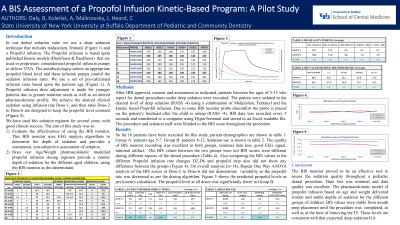
Purpose: This research will compare the scores gathered from a Bispectral Index (BIS) monitor with depth of sedation in pediatric patients undergoing a propofol infusion regimen for dental procedures. The BIS monitor provides a continuous, objective assessment via EEG analysis algorithms.
Methods: Patients between the ages of 5-13 who report for dental procedures under deep sedation will be recruited. The patient will be sedated to the desired level (RASS -4) using a combination of midazolam, fentanyl, and the kinetic-based propofol infusion. These doses are based on our deep sedation algorithm, which takes into account patients’ age and weight. To avoid discomfort, the probe is placed on the patient’s forehead after sedation. Raw data will be recorded every 5 seconds and transferred to a computer via HyperTerminal, and stored in an Excel readable file. Staff will be blinded to the BIS score throughout the procedure.
Results: As Institutional Review Board approval was recent, enrollment has not yet commenced. Data collection will entail 12 patients in the 5-7 age group and 12 patients between 8 and 12 years old. We expect the BIS scores for the patients to range between 60 and 70, reflecting deep sedation and possibly general anesthesia (BIS < 60).
Conclusions: This data collected will provide a baseline for future deep sedation studies. Further studies may compare different sedation algorithms, or the BIS scores of patients with neuroatypicalities such ASD or ADD.