
.png)
Sedation


Esther Kyung Ah Chung, DDS
Pediatric Dental Resident
University at Buffalo/Women and Children’s Hospital of Buffalo, Buffalo, NY
University at Buffalo School of Dental Medicine
BUFFALO, New York, United States
Kelly Plote, DDS
Pediatric Dental Resident
University at Buffalo/Women and Children’s Hospital of Buffalo, Buffalo, NY
University at Buffalo
Williamsville, New York, United States

Christopher Heard, MD
Attending Anesthesiologist
University at Buffalo
Buffalo, New York, United States
Allana Langen, Bachelor's of Science, Sociology and English
University Pediatric Dentistry
Jonathan Malinovsky, BS
University Pediatric Dentistry
Christopher Heard, MD
Attending Anesthesiologist
University at Buffalo
Buffalo, New York, United States
Carrie Wanamaker, DDS, DDS
Program Director, Advanced Education in Pediatric Dentistry
University at Buffalo
Buffalo, New York, United States
Purpose: This study evaluates the interrater reliability of a novel airway scoring system used by University Pediatric Dentistry to assess airway complications during office sedation procedures.
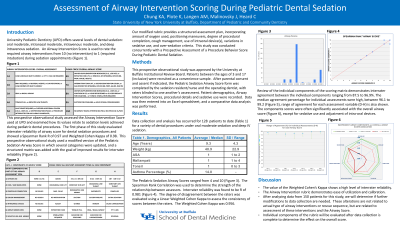
Methods: After University at Buffalo Institutional Review Board approval, children of 5 to 17 years of age who presented for dental sedation procedures were recruited. Their airway scores were assessed by either the sedating attending or the resident, in addition to the operating dentist. The practitioners submitted their scores to the research coordinator and were blinded to each other’s assessment. Patient demographics, health history, and procedural details were collected. After reviewing 100 cases, the scoring rubric was modified to include greater detail. Interrater analysis will be performed again after data collection on another 100 patients.
Results: After analyzing the initial 100 charts, interrater reliability was noted to be high, with a Spearman rank correlation of 0.97 and a weighted Cohen kappa of 0.98. These results were presented to the AAPD in 2021. The updated scoring rubric includes several additional airway interventions and a more structured datasheet; this allows for differentiation between the types of airway interventions required. To date, 135 cases have been studied; data collection will continue until a total of 500 patients are analyzed. Patient airway scores ranged from 4 - 10, with a median score of 6.
Conclusions: We anticipate that the alterations to the scoring system will improve interrater reliability. In addition, it will allow for greater quality assurance analysis for sedation.