
.png)
Special Health Care Needs


Serena ghodasra, DMD
Second Year Pediatric Dental Resident
Nova Southeastern University, Fort Lauderdale, FL
Nova Southeastern University
Davie, Florida, United States

Mitchell Gruzmark, DMD
Pediatric Dental Resident
Nova Southeastern University, Fort Lauderdale, FL
Nova Southeastern University
Hialeah, Florida, United States
Tara Sheehan, PhD
Nova Southeastern University
Oscar Padilla, DDS
NSU College of Dental Medicine
Davie, Florida, United States
Jennifer Chung, PhD, LMFT
Research Program Manager
NOVA Southestern University
Fort Lauderdale, Florida, United States

Judith R. Chin, DDS, MS
Pediatric Residency Program Director
NSU College of Dental Medicine
Nova Southeastern University College of Dental Medicine
Davie, Florida, United States
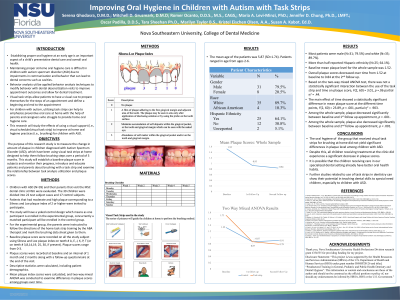
Purpose: The purpose of this continuation study is to measure the change in amount of plaque in children with Autism Spectrum Disorder (ASD) who have been using visual task strips at home designed to help them follow brushing steps over a period of three months. Task strips are utilized by behavior analysts to help individuals follow a routine when completing daily activities and its implementation in pediatric dentistry can allow for children to follow a more consistent and improved oral hygiene regimen. This study is designed to verify results of previous pilot study and achieve more robust results.
Methods: This pilot study will use a convenience sample of 30 children under 8 years old with ASD that visit the MSC dental clinic will be invited to participate in the study. Our sample size will include 15 test subject cases and 15 control subjects. As recording of plaque level is a routine process during dental exams, patients that have moderate and high plaque will be selected, which will correspond to a Silness and Loe plaque index of 2 or higher. The study has a yoked control and after data collection, results will be statistically analyzed.
Results: Pending- study ongoing
Conclusions: Based on an uncompleted previous project with promising preliminary results, we expect to see a reduction in plaque scores of patients using task strips that will be indicative of oral hygiene improvement. This study may provide a new preventative method to improve oral health.