
.png)
Special Health Care Needs


Melissa A. Mondesir, DMD
Pediatric Dental Resident
University Of Alabama at Birmingham Pediatric Dentistry
University of Alabama At Birmingham
Vestavia, Alabama, United States
Latoya A. Rolle, DDS
UAB Pediatric Dentistry Department
Rebecca Pikos, DMD
UAB Pediatric Dentistry Department
Stephen Mitchell, DMD
UAB Pediatric Dentistry
Birmingham, Alabama, United States
Stephen Mitchell, DMD
UAB Pediatric Dentistry
Birmingham, Alabama, United States
Janice G. Jackson, DMD
Chairman
The University of Alabama at Birmingham
Birmingham, Alabama, United States
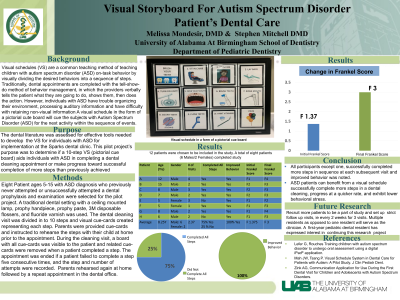
Visual schedules (VS) are a common method of teaching children with Autism Spectrum Disorder (ASD) on-task behavior by visually dividing the desired behaviors into a sequence of steps. Few studies have implemented VS in dentistry, so this pilot project’s purpose was to determine if a 10-step VS (pictorial cue board) aids individuals with ASD in completing a dental cleaning appointment.
Methods: Children ages 5+ with ASD diagnosis who previously never attempted or unsuccessfully attempted a dental prophylaxis and examination were selected for the pilot project. The dental cleaning visit was divided in to 10 steps and visual cue-cards created representing each step. Parents were provided cue-cards and instructed to rehearse the steps with their child at home prior to the appointment. During the cleaning visit, a board with all cue-cards was visible to the patient and related cue-cards were removed when a patient completed a step. The appointment was ended if a patient failed to complete a step five consecutive times, and the step and number of attempts were recorded. The primary outcome measures are the number of dental steps completed, and the number of attempts.
Results: Five patients completed study, and participants successfully completed more steps in sequence at each subsequent visit and improved behavior was noted.
Conclusion: ASD patients can benefit from a visual schedule successfully complete more steps in a dental cleaning, progress at a quicker rate, and exhibit lower behavioral stress.