
.png)
Patient Management


Vidisha Sharma, DMD
Pediatric Dentistry Resident PGY-2
Children's Hospital Colorado, Aurora, CO
Children's Hospital Colorado
Aurora, Colorado, United States
Kaci Pickett, MS
University of Colorado - Denver

Amandeep K. Pentlia, DDS, MPH
Pediatric Dental Resident
Children's Hospital Colorado, Aurora, CO
Aurora, Colorado, United States
Olivia Hautamaa, N/A
University of Colorado Anschutz Medical Campus
.jpg "Roopa P. Gandhi, BDS, MSD photo")
Roopa P. Gandhi, BDS, MSD
Residency Program Director
Children's Hospital Colorado
Aurora, Colorado, United States

Chaitanya P. Puranik, B.D.S., M.S., M.Dent.Sci., PhD
Director of Predoctoral Education in Pediatric Dentistry
Children's Hospital Colorado and School of Dental Medicine, University of Colorado Anschutz Medical Campus
Children's Hospital Colorado and School of Dental Medicine, University of Colorado Anschutz Medical Campus
Aurora, Colorado, United States
Chaitanya P. Puranik, B.D.S., M.S., M.Dent.Sci., PhD
Director of Predoctoral Education in Pediatric Dentistry
Children's Hospital Colorado and School of Dental Medicine, University of Colorado Anschutz Medical Campus
Children's Hospital Colorado and School of Dental Medicine, University of Colorado Anschutz Medical Campus
Aurora, Colorado, United States
Roopa P. Gandhi, BDS, MSD
Residency Program Director
Children's Hospital Colorado
Aurora, Colorado, United States
Purpose: The retrospective study evaluated the impact of the coronavirus pandemic on the dynamics of emergency dental care at a children’s hospital.
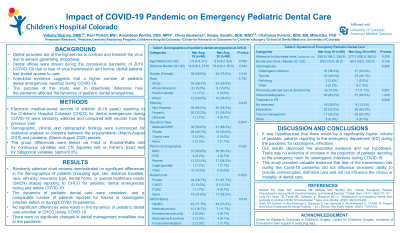
Methods: Electronic medical-dental records of children (0-18 years) reporting to the Children’s Hospital Colorado for pediatric dental emergencies between December 2018-December 2020 were randomly selected. The number, type, and factors associated with emergency visits during were assessed for all emergencies reporting during pandemic and a comparable pre-pandemic period from prior year. Demographic information was reported in percentages or mean±SD. Group differences were tested via t-test or Kruskal-Wallis test for continuous variables and Chi Squared test or Fisher’s Exact tests for categorical variables. Alpha value was set at 0.05.
Results: Two hundred and forty charts were randomly selected for pre-pandemic and pandemic period. During the pandemic, 52 percent of cases reported for odontogenic infection. This was a decrease as compared to the year prior (56.4 percent). Similarly, 45 percent cases reported for trauma during pandemic while only 40 percent cases reported for trauma in the pre-pandemic period. There were no differences in race, ethnicity or number of miles travelled for dental care. The selection of advanced behavior management modality by the dental provider seemed to be unaffected by the pandemic.
Conclusions: The dynamics of emergency dental care at the children’s hospital were unchanged during the pandemic with comparable number of patients reporting for emergent care. There were no significant changes in dental management modalities due to the pandemic.