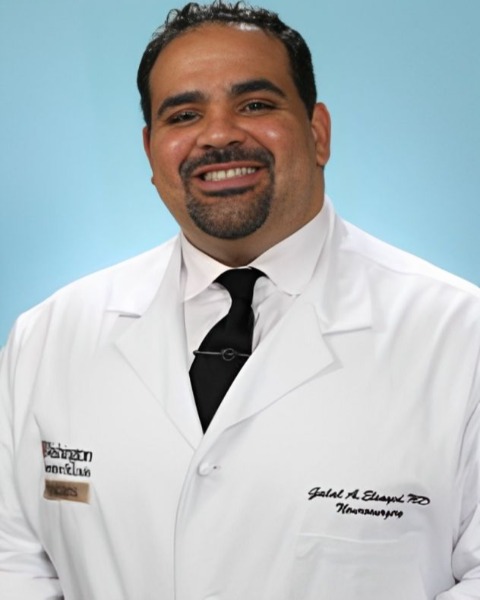
Complex Spine/MIS Deformity Fellow Washington University School of Medicine in St. Louis, United States
Introduction: Symptomatic immobile spondylolisthesis with severe circumferential stenosis consisting of foraminal, lateral recess, and central canal stenosis can be managed with indirect decompression and/or direct decompression. Recent evidence suggests a favorable risk profile for the use of standalone grafts for indirect decompression if there is age-appropriate spinal alignment and normal bone density. Herein, we present the first single prone position, dual surgeon simultaneous navigated prone lateral standalone graft placement with endoscopic unilateral laminectomy for bilateral decompression (ULBD) for symptomatic immobile spondylolisthesis with severe foraminal and canal stenosis.
Methods: The patient's standing scoliosis films revealed an sagittal vertical axis of 1.5 cm. The patient had a normal bone density. The patient is placed in the prone position in an open Jackson table with contralateral bolsters. A mounting bracket is placed ipsilateral to the prone lateral approach. For draping, the use of folded surgical towels facilitates a barrier for the irrigation used during the endoscopic decompression to help keep the field of the prone lateral approach clear of irrigation. Contralateral to the prone lateral approach, the endoscopic surgeon utilizes the navigated instrumentation to plan their incision for the ULBD. The endoscopic surgeon begins their approach and the navigated instrumentation is offered to the surgeon performing the prone lateral approach. The discectomy is performed and the interbody is trialed and placed as the endoscopic surgeon completes their ULBD with the use of a stenosis kit endoscopic set.
Results: At one month follow up, the patient shows no signs of axial mechanical back pain, no immobility on her dynamic lumbar radiographs, durable pain relief, and well healed wounds through both approaches. Her postoperative imaging shows a maintained sagittal vertical axis, without new deformity or malalignment. Her neurogenic claudication and bilateral radiculopathy are resolved without signs of subsidence on imaging.
Conclusion : A single prone position, dual surgeon simultaneous combined indirect/direct endoscopic decompression technique for symptomatic immobile spondylolisthesis can be a safe, effective, and efficient method for treating the radiculopathy and neurogenic claudication while offering anterior column support and restoring disc height in the setting of an age-appropriate sagittal vertical axis and normal bone density.