(I-615) Intracranial hypertension caused by acute bleeding of Capillary Hemangioma of the cauda equina complicated by Superficial Hemosiderosis: a case report
Director of Department of Neurosurgery Hokkaido Ohno Memorial Hospital Sapporo, Hokkaido, Japan
Introduction: Intradural extramedullary capillary hemangiomas are benign vascular tumors and the cauda equina lesion is extremely rare. Chronic bleeding of spinal tumors into the cerebrospinal fluid can lead to superficial siderosis of the central nervous system and there is a possibility that intracranial pressure increases by acute bleeding.
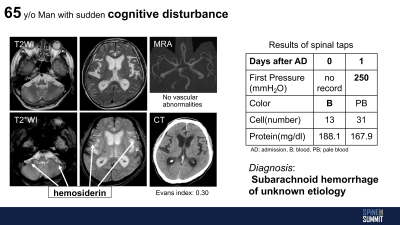
Methods: We report the case of a 65-year-old man who presented with sudden cognitive disturbance. He is a dairy farmer and has lumbago 3 days ago. His medical history was the intradural extramedullary lesion at L1-2 level 20 months ago, however, he had no previous history of axial back pain or radicular leg pain, or bowel or bladder incontinence. Diagnosis of superficial siderosis complicated by a mild ventricular enlargement was made on brain magnetic resonance imaging (MRI). The spinal tap showed bleeding and high intracranial pressure. A preoperative physical examination showed cerebellar ataxia and myelopathy and he needed regular lumbar punctures to remove excess fluid. MRI of the lumbar spine demonstrated a no gadolinium-enhanced intradural mass, iso- and partial hyperintense in T1-weighted and iso- and hypointense in T2-weighted images. After laminectomy and dura opening, a mulberry-like soft mass with minor bleeding was completely resected.
Results: Histopathological and immunohistological results were capillary hemangioma. The postoperative intracranial pressure was normal and the progression of the neurological deterioration was prevented. According to the results, the symptoms may have been associated with increased intracranial pressure secondary to acute bleeding of this tumor.
Conclusion : Capillary hemangiomas should be in the differential diagnosis of intradural extramedullary mass of cauda equina, especially in case of atypical findings on MRI. Our report demonstrates the importance of early diagnosis of superficial hemosiderosis and surgical management for spinal tumors, with imaging examination of the brain and whole spine to identify the source of bleeding, prevent disease progression, and improve prognosis even in asymptomatic patients. Moreover, any tumoral lesion even without signs of bleeding should be considered for resection.