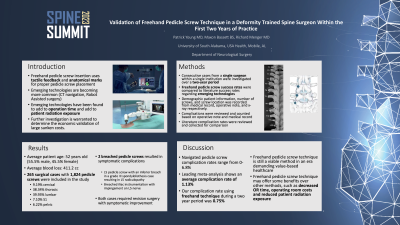
Introduction: Enabling technologies such as navigation and robotics have dominated the spine surgery literature regarding the placement of pedicle screws. Investigation is warranted to determine the economic validation of large sunken costs. Arguments surrounding navigation and robotics are secondary to concerns regarding the safety and accuracy of freehand pedicle screw placement. Here we illustrate the freehand pedicle screw placement of a spine deformity surgeon within the first two years of practice. We ask is the technical complication rate for a new surgeon ( < 2 years of practicing) using the freehand technique comparable to the navigation methods?
Methods: Consecutive cases from a single surgeon within a single institution were investigated over a two-year period. Demographic patient information, number of screws, and screw location were recorded from the medical record, operative note, and x-ray respectively.
Results: There were a total of 265 surgeries involving the placement of pedicle screws. The average patient age was 52 years old with 55.5% male. Average blood loss was 411.2 cc. From these 265 surgeries there were 1824 total pedicle screws counted: 9.19% cervical, 38.34% thoracic, 39.93% lumbar, 7.10% S1, and 6.22% pelvic. There were only 2 specific technical symptomatic technical complications throughout the entirety of the 2-year span reviewed which leads to a 0.75% complication rate. One was a L5 pedicle screw with an inferior breach in a grade III spondylothesis case resulting in L5 radiculopathy. The second case with on iliac instrumentation with impingement on L5. Both required revision with operative improvement
Conclusion : The literature navigation rates range from 0-6.8% with a leading meta-analysis showing a 1.35% complication rate. This allows for the conclusion that with proper intra-operative safety adjuncts, proper planning, and an adequately trained surgeon, freehand pedicle screw placement can be a viable option in the era demanding value-based healthcare.