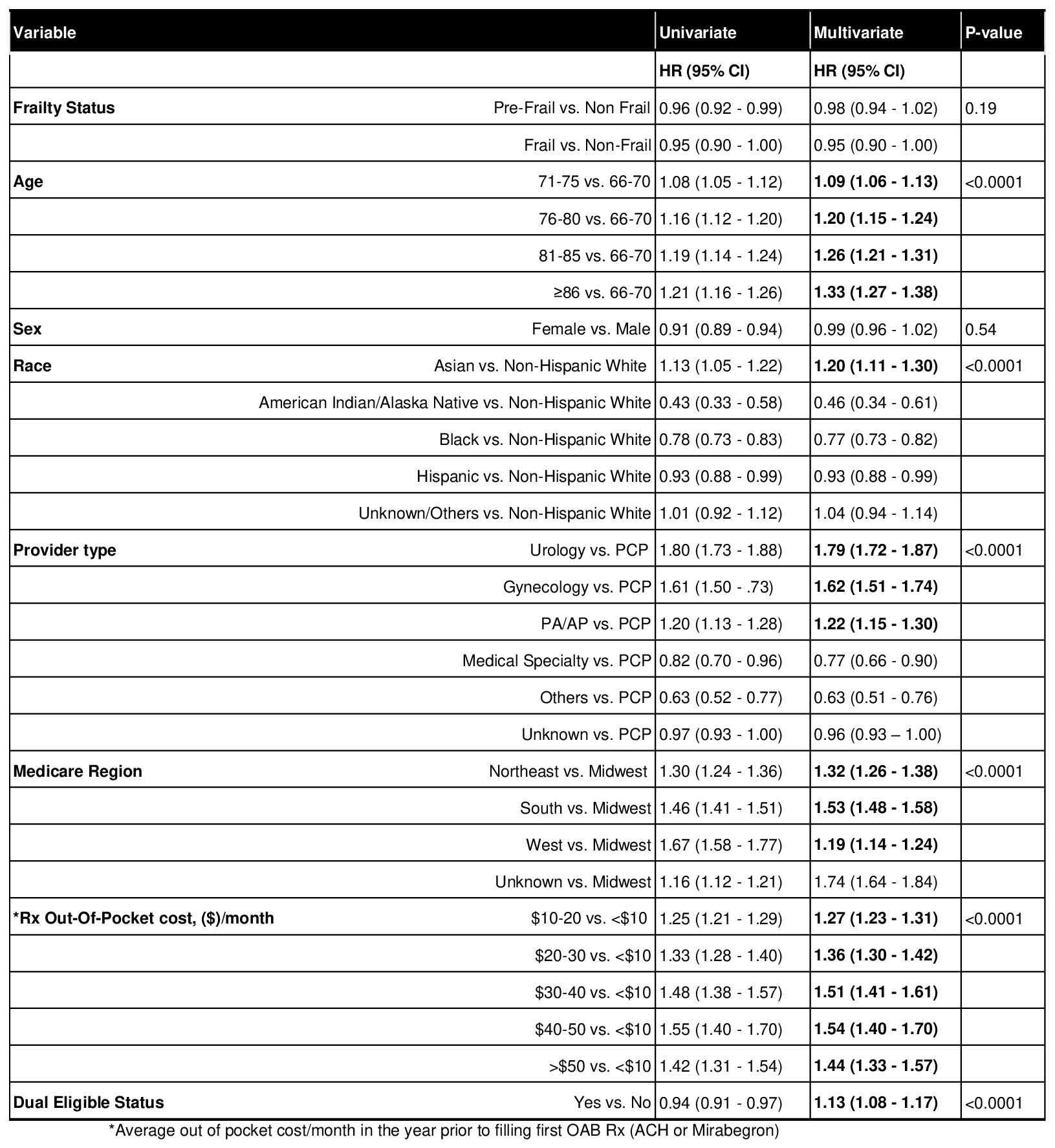
Introduction: Overactive bladder (OAB) is a chronic debilitating condition. Frailty is associated with age but is increasingly recognized as a more impactful determinant of health outcomes than chronological age. Increasing frailty and age are associated with OAB. Given the impact of OAB on quality of life multiple societies recommend treatment but advise caution in frail patients. The American Urologic Association advises caution when prescribing antimuscarinics in frail elderly patients and patients with dementia, severe constipation, or baseline anticholinergic use, recommending the use of beta 3 agonists alternatively. This study aimed to describe the prevalence of frailty in OAB Medicare beneficiaries and evaluate the impact of frailty on oral OAB therapy utilization patterns. Methods: Medicare beneficiaries =65 years old with a diagnosis of OAB were examined between 2013 and 2018. Beneficiaries were stratified using the Claims-Based Frailty Index (CFI) into 3 categories: not frail (CFI <0.15), prefrail (0.15 =CFI <0.25) and frail (CFI >0.25). Cox proportional hazard regression models were used to assess the impact of frailty status and socioeconomic status (SES) on mirabegron utilization using Medicare Part D prescription claims data. A test of collinearity was performed. Results: A total of 109,274 patients (15.4% of the overall OAB cohort) treated with antimuscarinics or mirabegron were identified during the study period of whom 71% were women and 81% were White. Overall 12,963 (11.9%) were frail. On multivariate analysis, advancing age (HR 1.33), White and Asian race (HR 1.20), urology (HR 1.79) and gynecology (HR 1.62) providers, South region (HR 1.53), and dual-eligible status (HR 1.13) were independently associated with mirabegron utilization. Frailty (HR 0.95) was not independently associated with mirabegron utilization. Conclusions: Age, race, SES, Medicare region and provider type were independently associated with filled mirabegron prescriptions while frailty was not. Urology and gynecology patients were more likely to fill mirabegron than primary care and other medical specialists. The study highlights the importance of evaluating for both frailty and age and the need to educate providers on the concerns of prolonged antimuscarinic use for frail and older OAB patients. SOURCE OF Funding: NICHD R25 HD094667, NIH NIDDK K23 DK131315-01A1