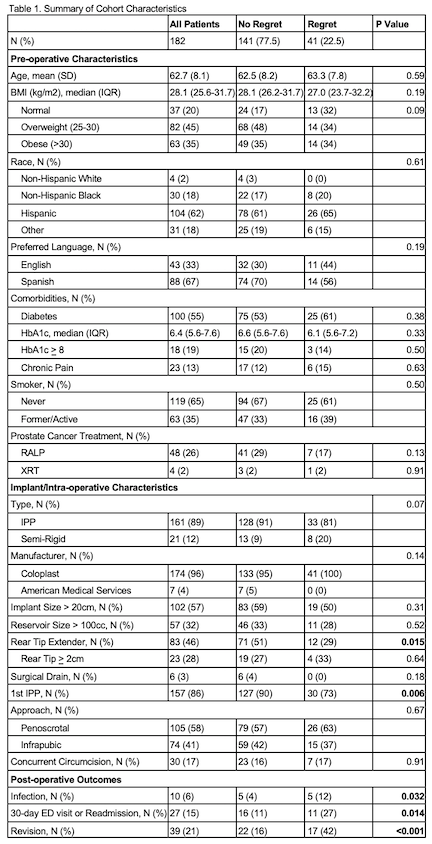
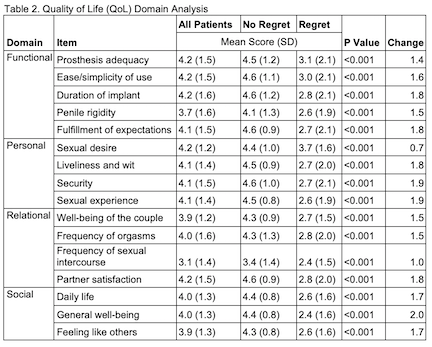
Introduction: Few studies have explored patient-reported outcomes and decisional regret after penile prosthesis implantation. In this study we explore decisional regret after penile prosthesis surgery in a high volume, racially diverse urban center. Methods: Patients who underwent penile prosthesis surgery from 2016 to 2022 at a single center were identified using CPT codes 54400, 54405, 54410, 54411, and 54415. After IRB approval, patients were called to administer the Quality of Life and Sexuality with Penile Prosthesis (QoLSPP) questionnaire along with questions evaluating decisional regret. We defined regret as being unsatisfied/ambivalent about one’s decision to get the prosthesis or unsure about undergoing the procedure again. Demographic, medical, and implant characteristics were collected through chart review. Statistics were performed using SPSS. Results: Out of 676 patients, 381 were successfully contacted and 182 completed the survey (response rate 50%). 41 (23%) patients experienced regret while 177 (78%) did not. The regret group was less likely to have rear tip extenders (RTE) (29% vs 51%, p=0.015) and more likely to have had a post-operative infection (12% vs 4%, p=0.032), 30-day ED visit/readmission (27% vs 11%, p=0.014), and be a revision (42% vs 16%, p<0.001). (Table 1) The regret group had significantly lower mean scores in all of the QoL domains compared to the no regret group (p < 0.001). (Table 2) On multivariate analysis, obesity (OR: 0.16, CI 0.05-0.57), RTE (OR: 0.33, CI 0.13-0.83), and infrapubic approach (OR: 0.09, CI 0.03-0.26) were associated with less regret after adjusting for age, preferred language, BMI, approach, and revision. Conclusions: One out of 4 men in this study reported decisional regret after penile prosthesis surgery. These men more frequently experienced post-operative infection or required surgical revision. Obesity, RTE use, and infrapubic approach were associated with less regret. Pre-operative counseling to ensure understanding of potential complications and manage patient expectations may reduce decisional regret. SOURCE OF Funding: None