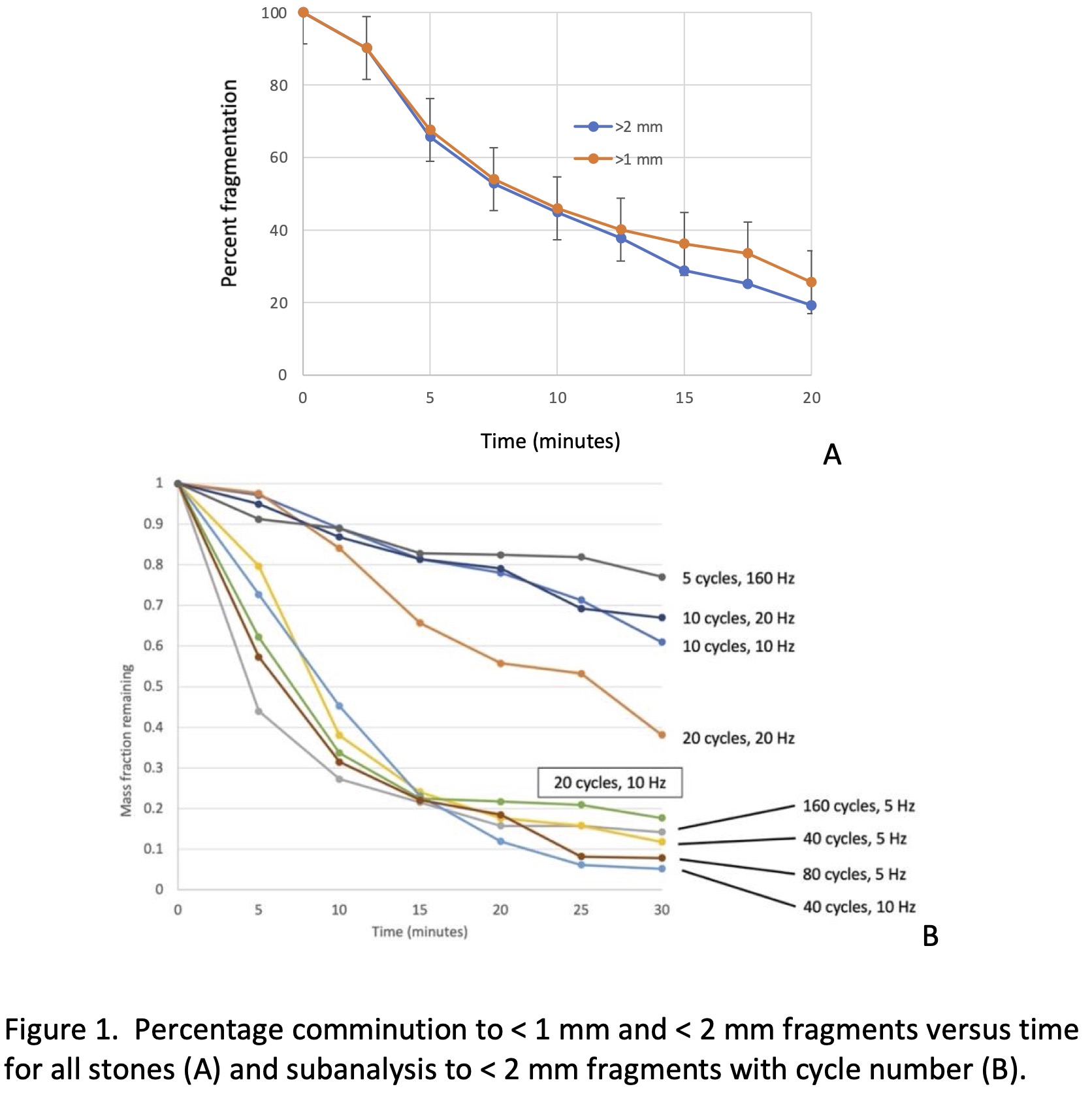
Introduction: The first in human trials of burst wave lithotripsy (BWL) demonstrated consistent fragmentation of upper tract stones with no or mild hematuria. However, for a randomized, controlled trial of treating 2-7 mm stones we wanted improved image resolution to not miss any fragments and ability to break stones to <1 mm at skin to stone depths of 4-10 cm on ultrasound. The system was redesigned and tested to add these improvements. Methods: A new ultrasound platform for imaging, ultrasonic propulsion, and BWL was designed and constructed (‘Propulse2’). The imaging employed high-bandwidth phased array probes and Verasonics Vantage imaging engine. Resolution changes were compared against existing devices in a standard imaging phantom. Longer focus therapy transducers were designed. Additionally, the transducers operate at frequencies between 350-800 kHz. A high-power pulse generator was developed to achieve pressure at greater depths, produce longer duration pulses, and enable interleaving BWL with ultrasonic propulsion pulses and accelerate fragmentation. To test the therapeutic capabilities, rehydrated 2-7 mm calcium oxalate monohydrate stones were sonicated with each transducer and frequency in a calyx phantom in 2.5-minute intervals for 20 minutes. After each interval, the fragments were weighed and sieved to 1 and 2 mm, then returned to the phantom. Burst cycle durations between 5 to 160 cycles were tested with and without interleaved pulses and depths 4-10 cm all at focal peak negative pressures of 7 MPa. Results: Imaging contrast (signal to noise ratio) with the old and new systems was 1.62 and 3.45 at 6 cm depth and 1.07 and 1.75 at 10 cm depth. Lateral resolution was improved by a factor of 2.1 at 6 cm and 2.5 at 10 cm. Targeting accuracy was measured to be within 1 mm for all transducers. On average for all stones and conditions, 81% and 75% of the stone mass was comminuted to < 2 mm and < 1mm fragments respectively in 20 minutes (Fig. 1A). Subanalysis of fragmentation to < 2 mm fragments showed fewer than 20 cycles were less effective even with increased pulse repetition rate to equalize energy (Fig. 1B). Conclusions: The system demonstrated over twice the imaging contrast and resolution and capability to fragment stones more finely over a 4-10 cm depth. Propulse2 has been approved for human trials (ClinicalTrials.gov number, NCT04796792). SOURCE OF Funding: Work supported by NIDDK P01 DK043881.