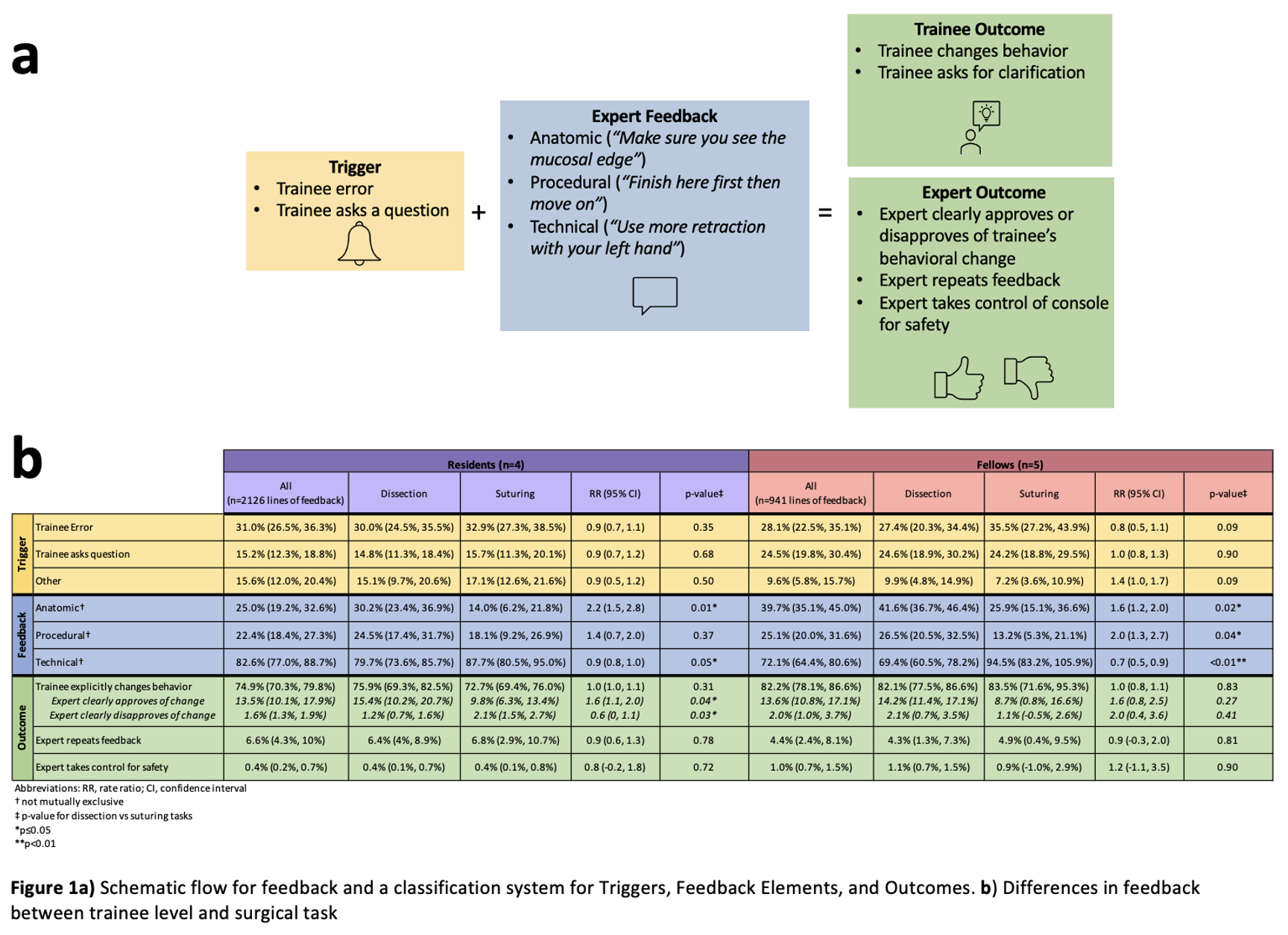
Introduction: Feedback is essential in surgical training. While all trainees meet case minimums, the feedback they receive can vary in content and quality. We capture the intraoperative feedback provided to trainees during live urologic robotic cases and propose a standardized deconstruction for feedback. Methods: Eight attending surgeons and nine trainees were prospectively recorded during robotic surgeries at our institution from April-August 2022. Endoscopic video was captured directly from the surgeon console. Dialogue between experts and trainees was recorded with clip-on microphones. A schematic flow for feedback and a classification system for Triggers, Feedback Elements, and Outcomes was developed (Fig. 1a) and inter-rater reliability between three trained raters was calculated using prevalence-adjusted and bias-adjusted kappa (PABAK). To examine differences in these classification categories by trainee experience level, we first used generalized estimating equations to estimate weighted average rates across residents and fellows. Next, we used rate ratio (RR) to compare differences in these categories between surgical tasks (dissection vs suturing). Results: Raters had moderate agreement in identifying Trigger, Feedback, and Outcome categories (PABAK 0.6-1.0). In total, 25 robotic teaching cases yielded 3,067 unique lines of feedback. A clear trigger was identified most of the time (59.6%, 95% Confidence Interval [CI] 55.4%, 64.2%). The most frequent trigger was trainee error (28.3%, 95% CI [24.4%, 32.8%]). Most feedback was purely technical (52.3%, 95% CI [46.3%, 59.1%]). The most often combined feedback elements were anatomic and technical components (20.3%, CI [17.3%, 23.8%]). Trainees received more anatomic feedback when performing dissection (RR 2.1, 95% CI [1.7, 2.5]) and more technical feedback when suturing (RR 1.1, 95% CI [1.0, 1.3]) (Fig 1b). Notably, experts repeated feedback less frequently for fellows than residents (RR 0.6, 95% CI [0.1, 1.1]). Conclusions: We developed a novel framework for feedback that not only captures the dynamic interaction between trainee and expert but accounts for resulting changes in behavior. Investigation into the relationships between Triggers, Feedback, and Outcomes may reveal avenues for optimizing feedback and skill acquisition in different teaching scenarios. SOURCE OF Funding: None