IRCCS Azienda Ospedaliero-Universitaria di Bologna, University of Bologna
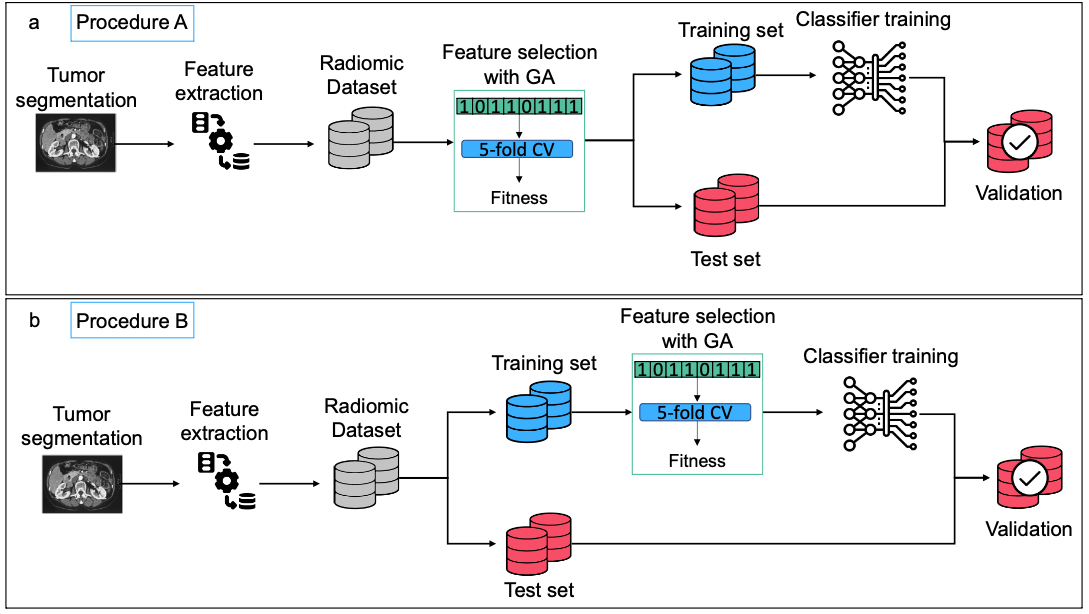
Introduction: The aim of this study was to build a machine learning model based on CT-derived radiomic features to discriminate renal oncocytoma (RO) from clear cell renal cell carcinoma (ccRCC), focusing on tumor zone of transition (ZOT) features capturing tumor characteristics which are usually overlooked. Methods: We collected CT images of 77 patients with a single T1a renal mass, who underwent partial nephrectomy at a single tertiary urologic center from January 2019 to December 2021. Radiomic features were extracted both from the tumor volumes identified by the clinicians and from the tumor ZOT, after images segmentation performed to carry out 3D virtual model. We used a genetic algorithm (GA) to perform feature selection, identifying the most descriptive set of features for the tumor classification. We built a decision tree classifier to distinguish between ROs and ccRCCs (Figure). We proposed two versions of the pipeline: in the first one the feature selection was performed before the splitting of the data, while in the second one the feature selection was performed after on the training data only. We evaluated the efficiency of the two pipelines in the cancer classification. Results: Overall, 30 cases had RO (39%) and 47 cases had ccRCC (61%) confirmed at final pathologic specimens. The ZOT features were found to be the most predictive by the genetic algorithm. The pipeline with the feature selection performed on the whole dataset obtained an average Receiver Operating Characteristic (ROC) Area Under the Curve (AUC) score of 0.87 ± 0.09. The second pipeline, in which the feature selection was performed on the training data only, obtained an average ROC AUC score of 0.62 ± 0.17. In both cases, 8 of the top 10 selected features were tumor ZOT features. Conclusions: The obtained results highlight the efficiency of tumor ZOT radiomic features in capturing the characteristics of pT1a renal tumors, and particularly in discriminating RO from ccRCC. The use of tumor ZOT features in radiomic analyses should be further investigated, as it may lead to important clinic implication with regards of better selection of patients for active treatment (surgery or ablation) vs. active surveillance. SOURCE OF Funding: None.