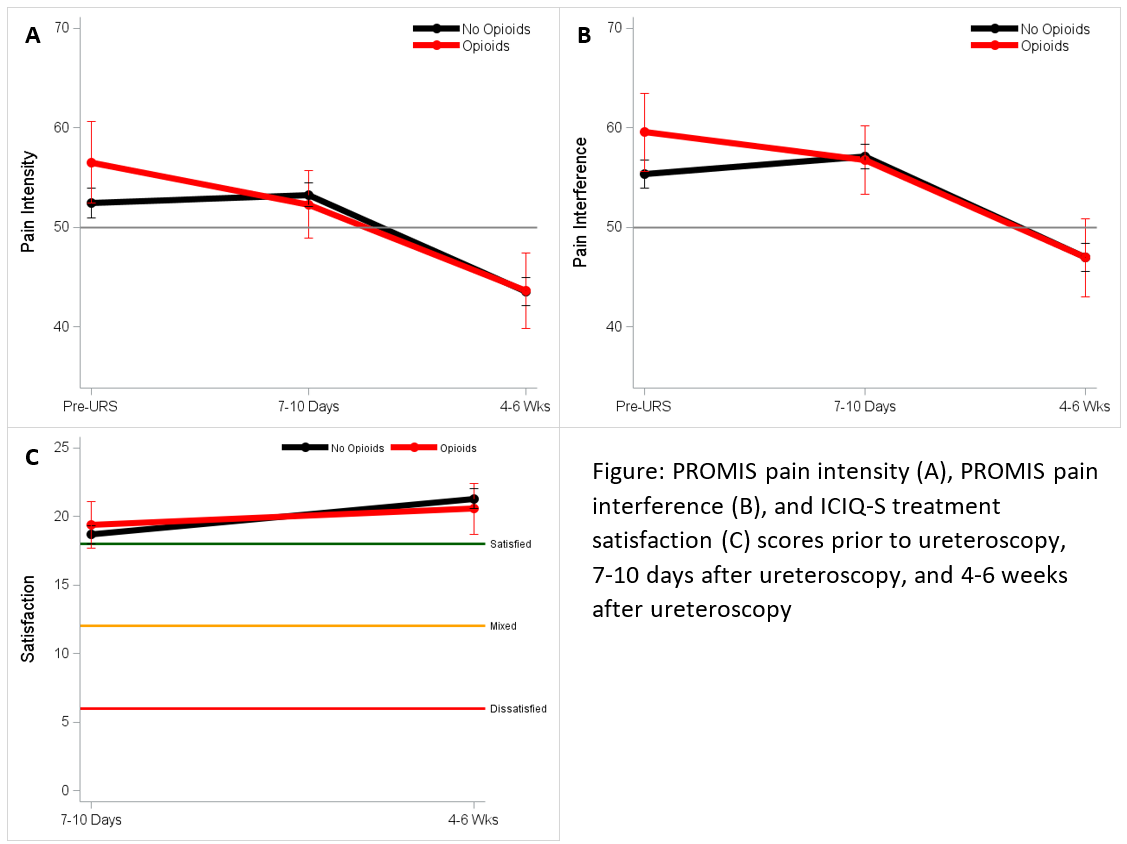
Introduction: The outcomes of kidney stone surgery have long been focused on stone-free rates and safety, yet patient reported outcomes (PRO) are often lacking. In 2018 the Michigan Urological Surgery Improvement Collaborative (MUSIC) Reducing Operative Complications from Kidney Stones (ROCKS) group initiated a pain optimization pathway using an opioid-free multi-modal pain regimen. This has resulted in a decline in opioid prescription rates after ureteroscopy (86 to 19%). We used a comprehensive PRO system to understand the initiative’s impact on patients’ experiences of treatment pain and satisfaction. Methods: MUSIC ROCKS instituted its patient-reported outcomes (PRO) program in 2020 which included an assessment of patient pain (PROMIS Pain Intensity short form and Pain Interference short form) and overall treatment satisfaction (ICIQ-S). This system is automated and distributes questionnaires preoperatively and at 7-10 days and 4-6 weeks following ureteroscopy (URS). We compared patients who were prescribed opiates after URS to those who were not. After adjusting for observed demographic differences (age, gender, pre-stent status, stone location/size, and preoperative pain), we evaluated PRO pain intensity and interference with linear mixed models. A clinically meaningful difference in PROMIS scores is 2.5-3.5 points. Treatment satisfaction scores were compared with Wilcoxon rank tests. Results: A total of 292 patients completed all questionnaires (258 non-opioid and 34 opioid). There was no significant difference between non-opioid and opioid cohorts with regards to age (60 vs 59 years), gender (50 vs 53% male), pre-stenting status (76 vs 65%), stone location (64 vs 59% ureteral), and stone size (8.0 vs 7.2 mm). After adjustment, there was no significant difference in preoperative pain intensity scores between the groups at pre-URS (p=0.06), 7-10 days postop (p=0.87), and 4-6 weeks postop (p=0.99, Figure). Pain interference followed a similar pattern, with no significant differences observed at any timepoint. There was no difference in satisfaction scores, as measured both 7-10 days (p = 0.46) and 4-6 weeks (p =0.47) after URS. Conclusions: Rates of opiate prescription have declined after URS in Michigan. Using a novel PRO system, we confirmed that utilization of opioid-free pathways has not resulted in increased pain nor decreased patient satisfaction. SOURCE OF Funding: Blue Cross Blue Shield of Michigan