MP50-14: A Multicenter Evaluation of the Prognostic Utility of Changes in Treatment-Associated Body Composition in Men with Germ Cell Tumors (GCT) of the Testis: Implications for Adverse Events and Complications
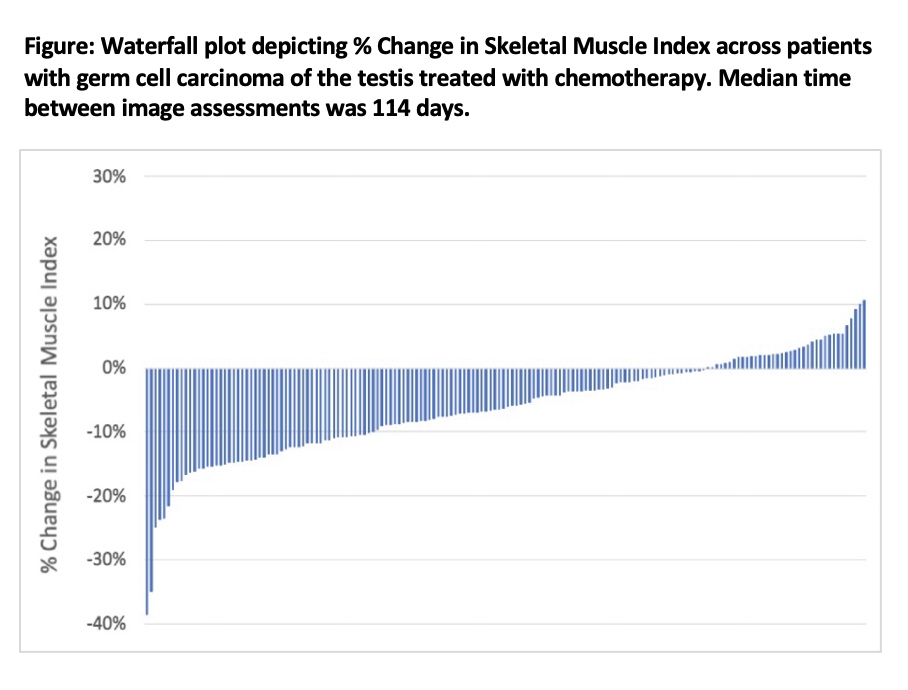
Introduction: Skeletal muscle mass is associated with oncologic outcomes and treatment-associated toxicity across malignancies. However, men with GCT are younger and less likely to suffer baseline age-related muscle loss. As such, the prognostic utility of body composition metrics in GCT is undefined. We aimed to quantify changes in body composition following cytotoxic chemotherapy (CC) for GCT and evaluate associations between these changes and rates of CC-associated adverse events (AEs) and post-retroperitoneal lymphadenectomy (RPLND) complications. Methods: This retrospective study included 216 patients with GCT (N=152 from Fred Hutchinson Cancer Center/ University of Washington; N=64 from Emory University Hospital) treated with CC and/or RPLND, with CT scans within 75 days before initiation and after completion of treatment. We analyzed L3 axial CT scans for skeletal muscle index (SMI), subcutaneous adipose index (SAI), and visceral adipose index (VAI). Logistic regression was used to evaluate associations between body composition metrics and grade 3+ AEs and Clavien 3+ post-RPLND complications. Results: Median age for the cohort was 30 years (IQR 25-39) of whom, 47% of men had nonseminomatous GCT (Stage IS, II, and III in 17%, 39%, and 42%, respectively). 182 men received CC including BEP (67%), EP (19%), and VIP (7%), with a median of 3 cycles while 34 men (33%) and 69 men underwent primary and post-CC RPLND, respectively. Median time between CTs was 114 days. Median change in SMI, VAI, and SAI was -6% (FIGURE), +13%, and +11%, respectively. Overall, 79 men (43%) experienced grade 3+ AEs, and 24 men (23%) experienced Clavien 3+ post-RPLND complications. On regression analysis, higher baseline VAI (p=0.048), lower post-CC SMI (p=0.008), and decreased SMI (p=0.047) were associated with increased risk of grade 3+ AE. No baseline body composition metrics or changes therein during CC predicted risk of post-RPLND complications. Conclusions: We observed a decline in skeletal muscle and an increase in adipose tissue following CC in men with GCT. Both skeletal muscle and adipose tissue metrics were associated with the incidence of chemotherapy-associated adverse events and may have the potential for use in risk evaluation. SOURCE OF Funding: None