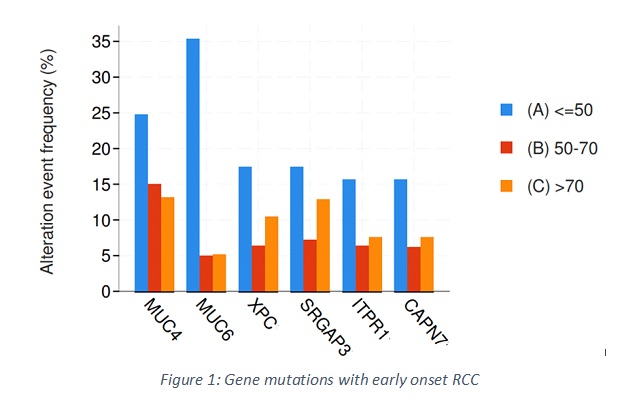
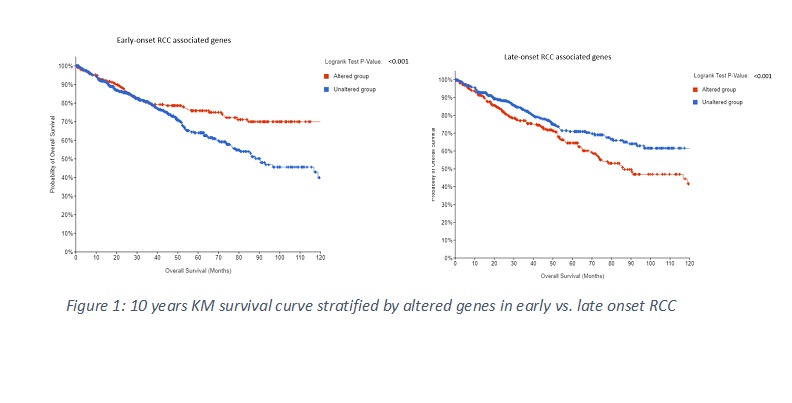
Introduction: The incidence of renal cell carcinoma (RCC) in younger age groups has steadily increased over the past two decades. However, the genetic and clinical characteristics of RCC in younger patients remain elusive. In this study, we performed targeted capture sequence to characterize the mutational spectrum of RCC patients across different age groups. Methods: We queried the American Association for Cancer Research Project Genomics Evidence Neoplasia Information Exchange registry. Key genes were identified in 1,081 patients diagnosed with RCC. We included mutations frequency rates of more than 5%. A total of 238 genes were sequenced in our cohort. Overall (OS) and progression free survival (PFS) rates were computed. SPSS V24 was used for analyses. Results: Patients were categorized into three groups: young (=50 years old) (n=263, 24.3%), middle-age (51-69 years old) (n=580, 53.6%), and old (=70 years old) (n=238, 22.1%). Of the 1,081 patients with RCC, 54% had clear cell histology; papillary RCC (26.5%) and chromophobe RCC (19.5%). The frequency of mutations affecting 6 genes (MUC4, MUC6, XPC, SRGAP3, ITPR1, CAPN7) were significantly higher in the young group compared to the other two groups (p <0.001) (Fig1). Older patients with had significantly higher frequency of VHL, SETD2, TTN genes mutations with worse PFS (p value <0.001) and OS (p <0.001). (Fig 2) Conclusions: We found distinct genetic variations among young and older patients with RCC. Gene mutation analysis in patients with RCC may provide prognostic information in future. SOURCE OF Funding: none