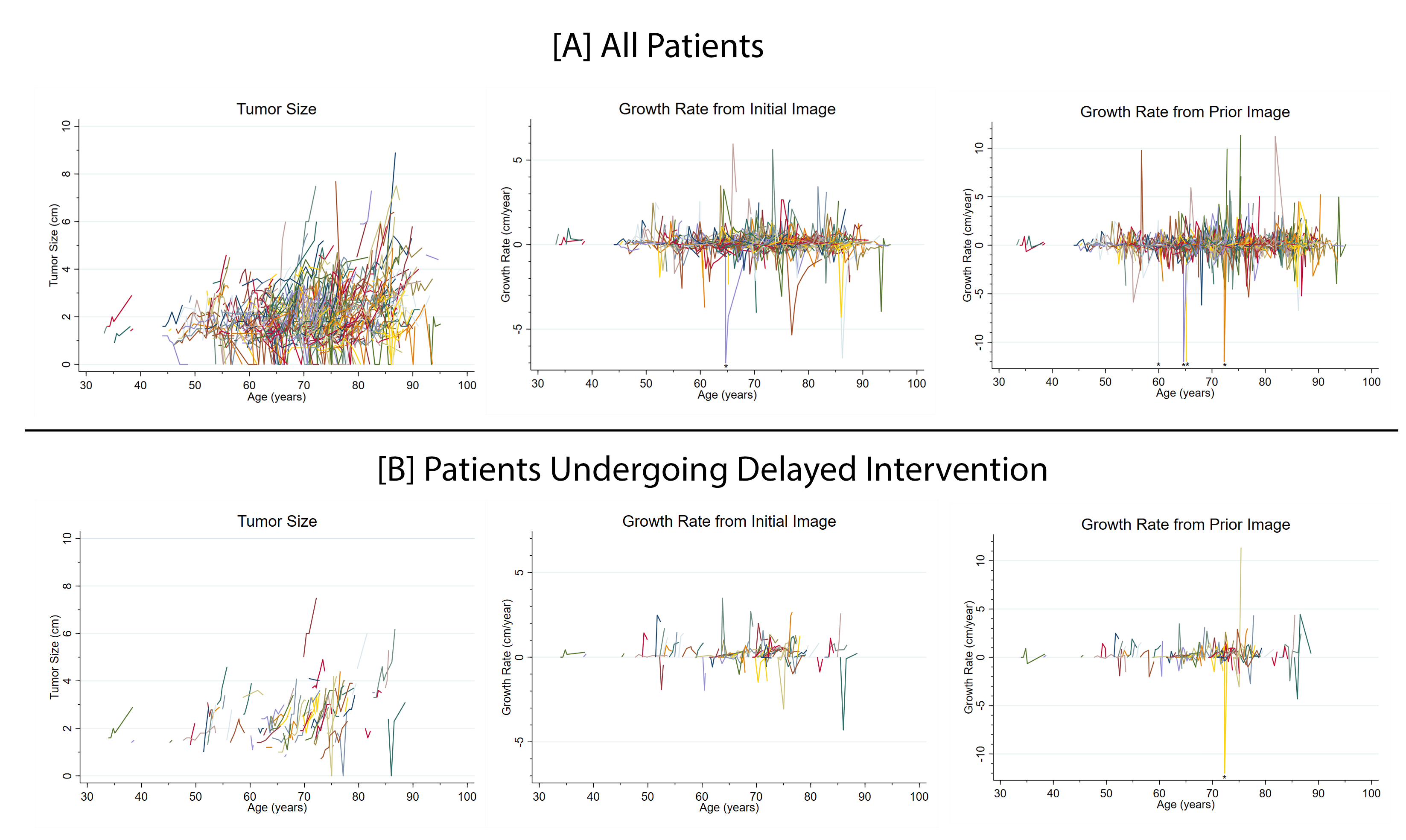
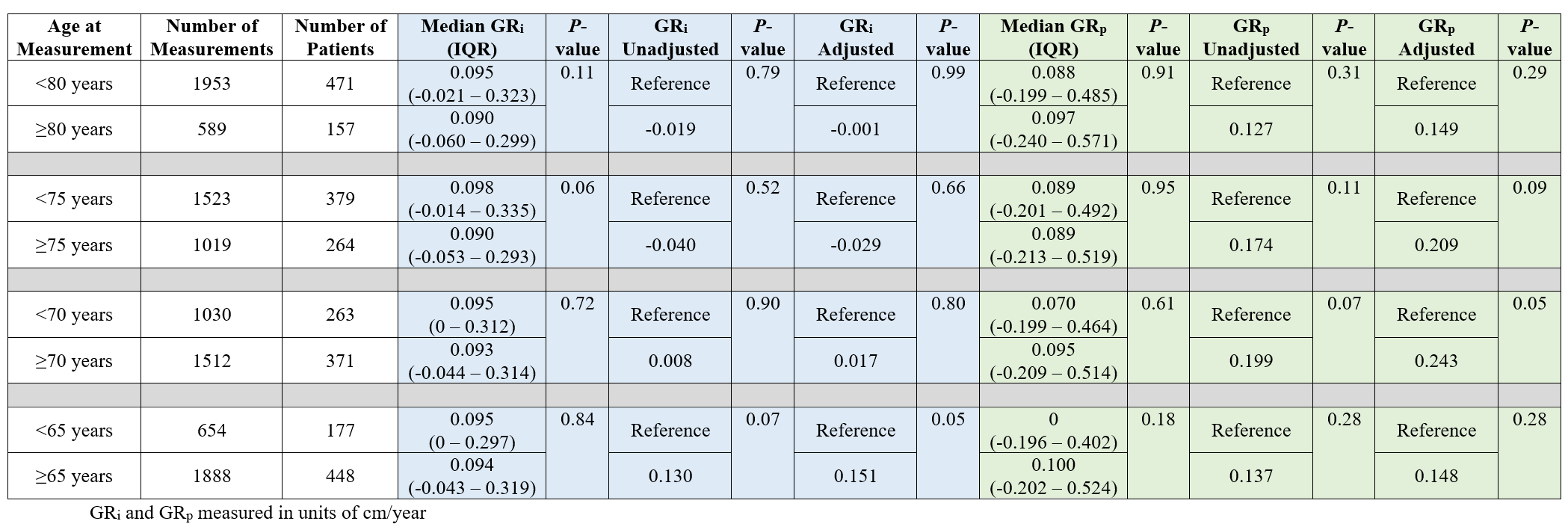
Introduction: Emerging data suggests that tumor microenvironments may differ among patients based on age, which can be of concern to patients who are enrolled in active surveillance (AS) for a prolonged period. We sought to examine if particular age cutoffs were associated with an increased growth rate (GR) for patients enrolled in AS for small renal masses (SRMs). Methods: The Delayed Intervention and Surveillance for Small Renal Masses registry is a prospective, multi-institutional study examining outcomes in patients undergoing AS for SRMs. Two definitions of GR were examined: growth rate from the initial image (GRi) and growth rate from the prior image (GRp). Image measurements were dichotomized based on patient age at the time of imaging. Multiple age cutoffs were examined: 65, 70, 75, and 80 years. Mixed effects linear regression examined associations between age and GR, with controlling to account for multiple measurements from the same individual. Results: We examined 2542 measurements from 571 patients [Figure]. The median age of patients at enrollment was 70.9 years (IQR 63.2-77.4) with a median tumor diameter of 1.8 cm (IQR 1.4-2.5). When examined as a continuous variable, age was not associated with GRi (-0.0001 cm/year, 95% CI -0.007 – 0.007, P=0.97) or GRp (0.008 cm/year, 95% CI -0.004 – 0.020, P=0.17) after adjustment. The only age thresholds associated with an increased GR were 65 years for GRi and 70 years for GRp [Table]. Patients who underwent delayed intervention had increased GRi (0.282 cm/year, 95% CI 0.078 – 0.487, P=0.007) but no difference in GRp (0.319 cm/year, 95% CI -0.032 – 0.670, P=0.07) compared to those who remained on AS. Conclusions: Patients with SRMs on AS do not exhibit a clear association between tumor GR and patient age, suggesting that AS is a safe and durable management option for aging patients with SRMs. SOURCE OF Funding: None.