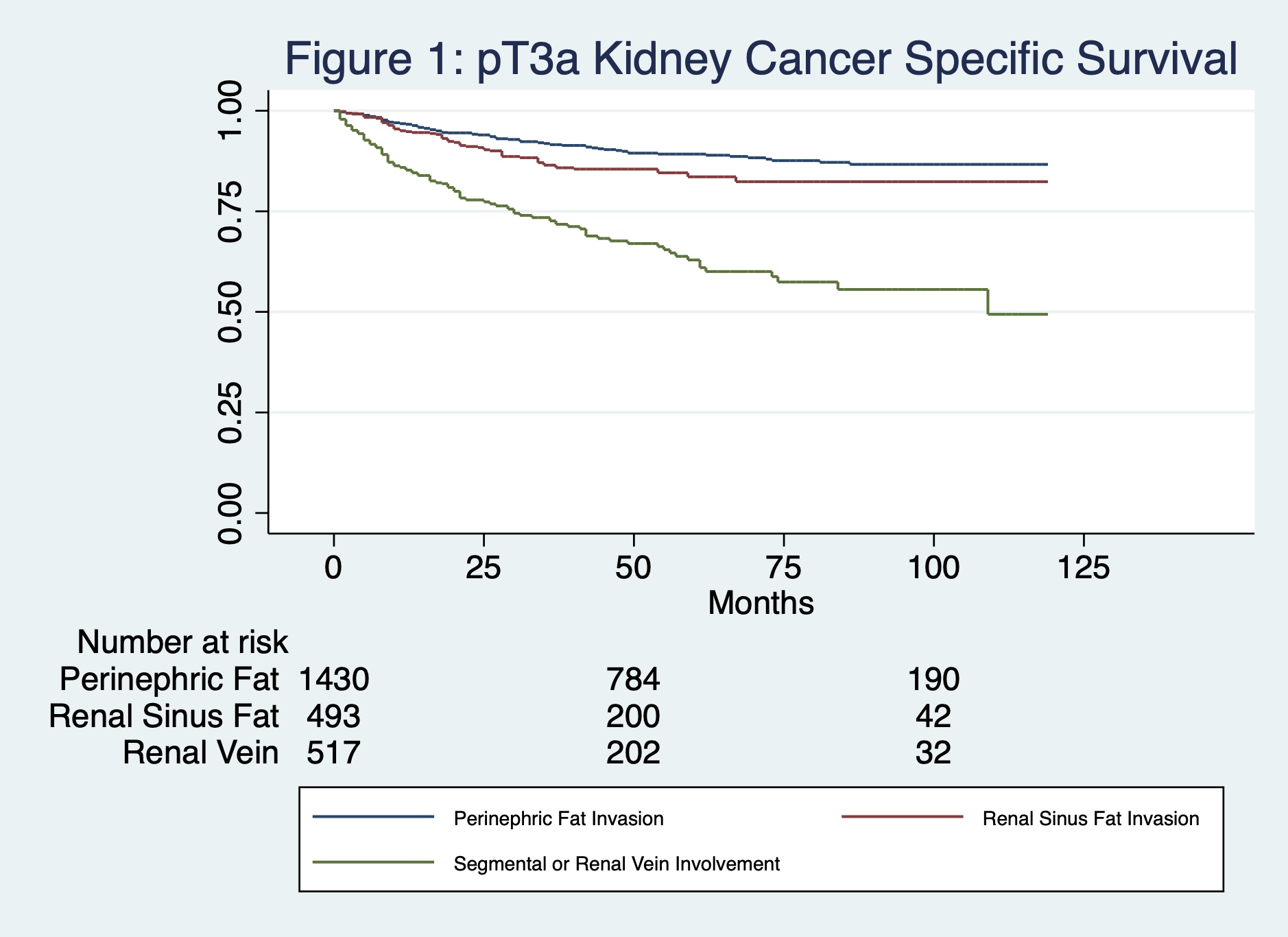
Introduction: Prior studies in clear cell renal cell carcinoma (RCC) have suggested that the pT3a staging subclassification based on perinephric fat, renal sinus fat, and renal vein invasion may represent an overly heterogenous group of patients with varying survival trajectories. A similar evaluation has not yet been performed in patients with non-clear cell pathology. Therefore, we examined the prognostic significance of perinephric fat, renal sinus fat, and renal vein invasion in pT3a non-clear cell RCC (nccRCC) patients. Methods: A population-based retrospective cohort study of patients with pT3aN0M0 nccRCC was performed using Surveillance, Epidemiology, and End Results (SEER) data for the years 2010 through 2019. Patients were grouped by pT3a subclassification: perinephric fat, renal sinus fat, and segmental or renal vein invasion. Cox proportional hazards models were used to examine the relationship between pT3a subclassification groups and cancer-specific survival, overall and by histological subtype (papillary, chromophobe, and other nccRCC tumors). Results: The final analysis sample consisted of 1,640 pT3aN0M0 nccRCC patients with a median follow up of 4 years. Compared to perinephric fat invasion, segmental or renal vein invasion was associated with significantly worse cancer-specific survival (hazard ratio [HR] 3.0, 95% CI: 2.1 – 4.3, Figure 1) overall. Of these patients, 51.1%, 38.4%, and 10.5% had papillary, chromophobe, and other nccRRC tumors, respectively. Among patients with papillary (HR 4.8, 95% CI: 2.8 – 8.3) and chromophobe (HR 2.9, 95% CI: 1.1 – 7.9) pT3a tumors, segmental or renal vein invasion was associated with significantly worse cancer-specific survival compared to perinephric fat invasion. No difference was observed in cancer-specific survival by pT3a subgroups for other nccRCC tumors. Patients with two pT3a characteristics had significantly worse cancer-specific survival compared to those with only one (HR 2.1, 95% CI: 1.5 to 3.1). Conclusions: Cancer-specific survival is significantly worse in pT3a nccRCC patients with segmental or renal involvement, particularly in those with papillary and chromophobe tumors. Current RCC staging guidelines may underestimate the prognostic value of segmental or renal vein involvement relative to other pT3a criteria. SOURCE OF Funding: None

.jpg "Michael Rezaee, MD photo")