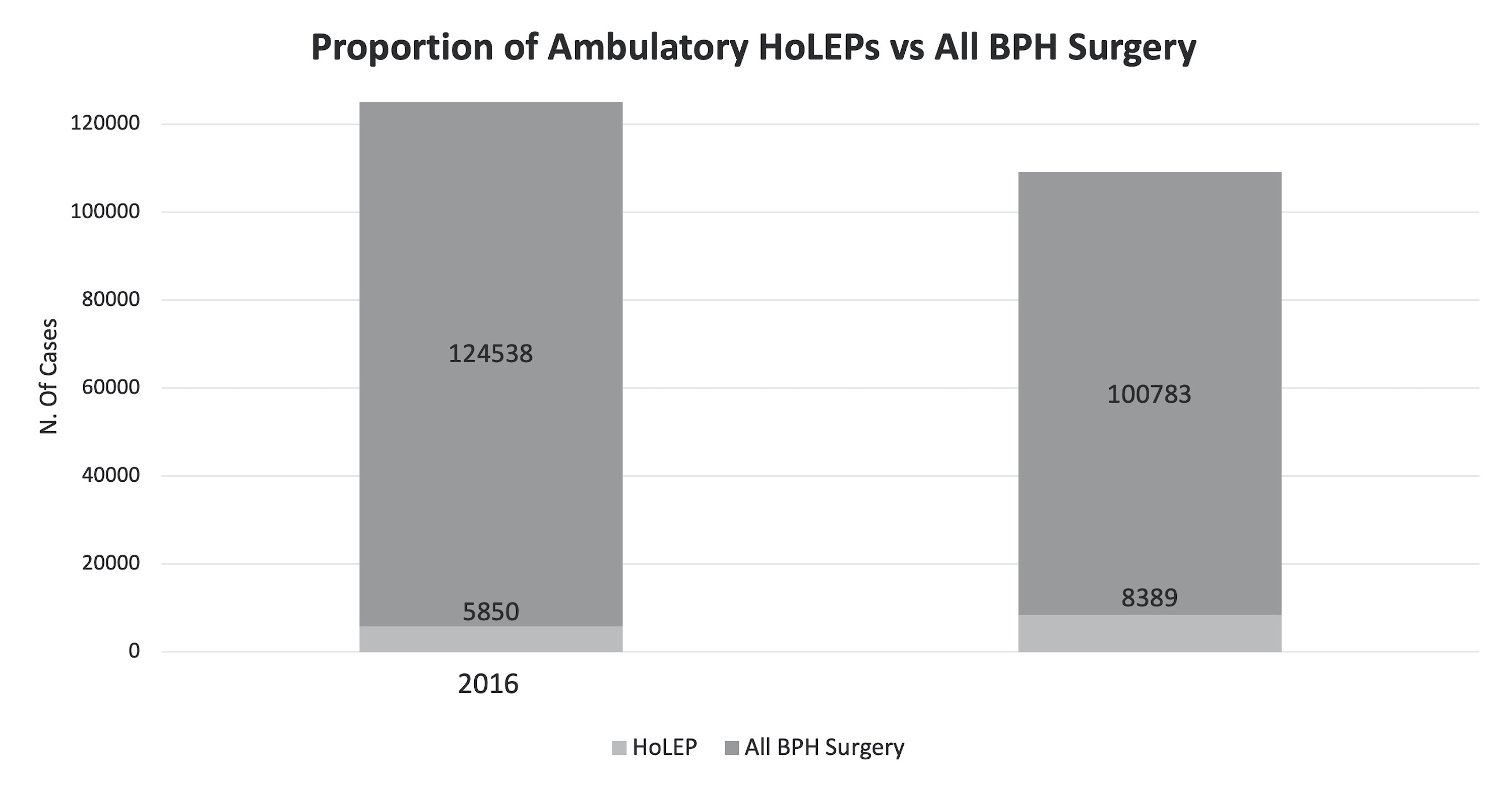
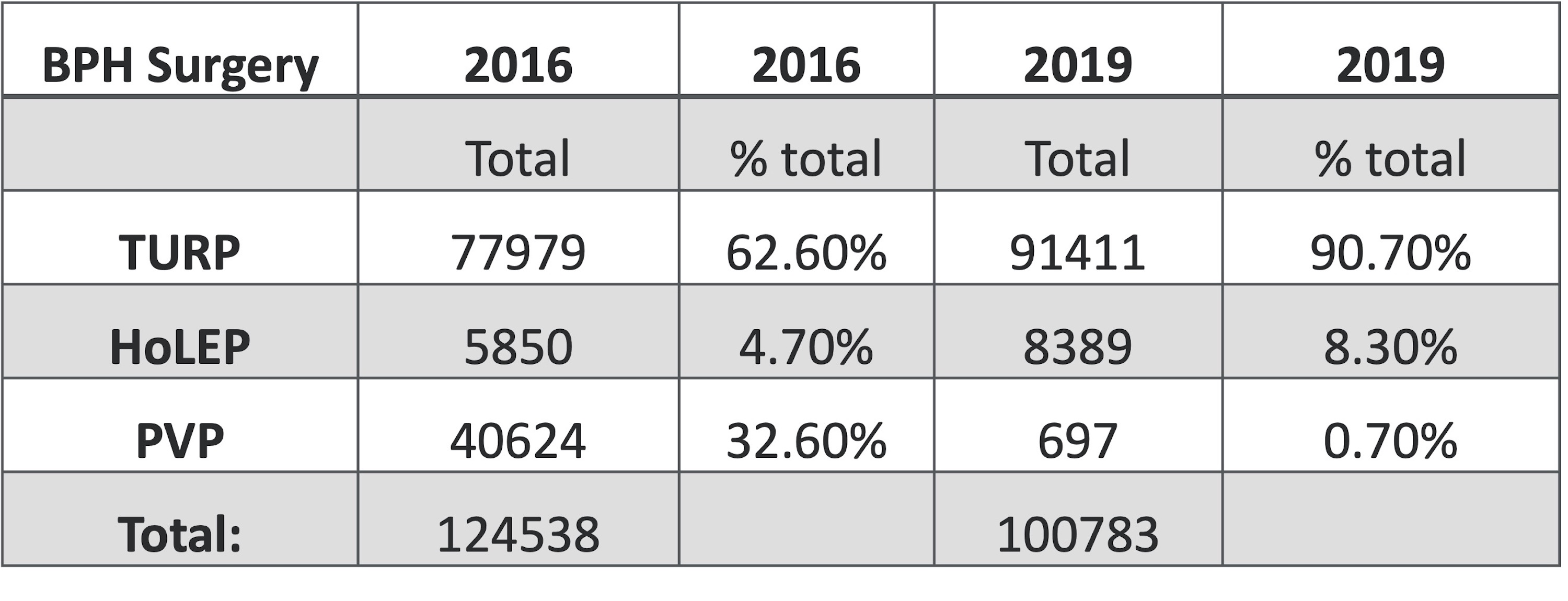
Introduction: Holmium laser enucleation of the prostate (HoLEP) has evidenced-based advantages in treating benign prostatic hypertrophy (BPH) relative to other interventions. Unfortunately, adoption of HoLEP has remained relatively low in Medicare and NSQIP populations. Its role as an inpatient surgical intervention is changing as advancements in the technique and systems have demonstrated the feasibility of same-day discharge. Thus, our objective was to evaluate national HoLEP trends in ambulatory surgery settings from 2016-2019. Methods: The Nationwide Ambulatory Surgery Sample (NASS) is the largest national all-payer database of ambulatory surgical encounters, managed by the Agency for Healthcare Research and Quality. A cross-sectional, retrospective analysis of the 2016 and 2019 NASS was performed. Rates of BPH surgeries were calculated and stratified by age, census region, and primary payer to compare across time-points for trends. Chi-squared and ANOVA was completed for categorical and continuous variables, respectively. Results: The total number of BPH surgeries fell 20% between 2016 (n=124,538) and 2019 (n=100,593) (Figure 1). In 2016, HoLEP lagged behind prostatic photovaporization (PVP) and Transurethral Resection of Prostate (TURP) with 4.7% of surgeries, but rose to the second most-common procedure in 2019 with 8.3% of total surgeries (Table 1). TURP was the most common intervention (62.6% in 2016, 90.7% in 2019). Simple prostatectomy was the most expensive intervention. By US census region, more HoLEPs were done in the South (43.1% in 2016, 37.5% in 2019) and Midwest (26.8% in 2016, 31.7% in 2019). Conclusions: Overall, HoLEP uptake is increasing in ambulatory settings. HoLEP has replaced greenlight PVP as the second-most frequently used intervention. The rate of ambulatory HoLEPs has nearly doubled despite a general decrease in the overall number of BPH surgeries. SOURCE OF Funding: None