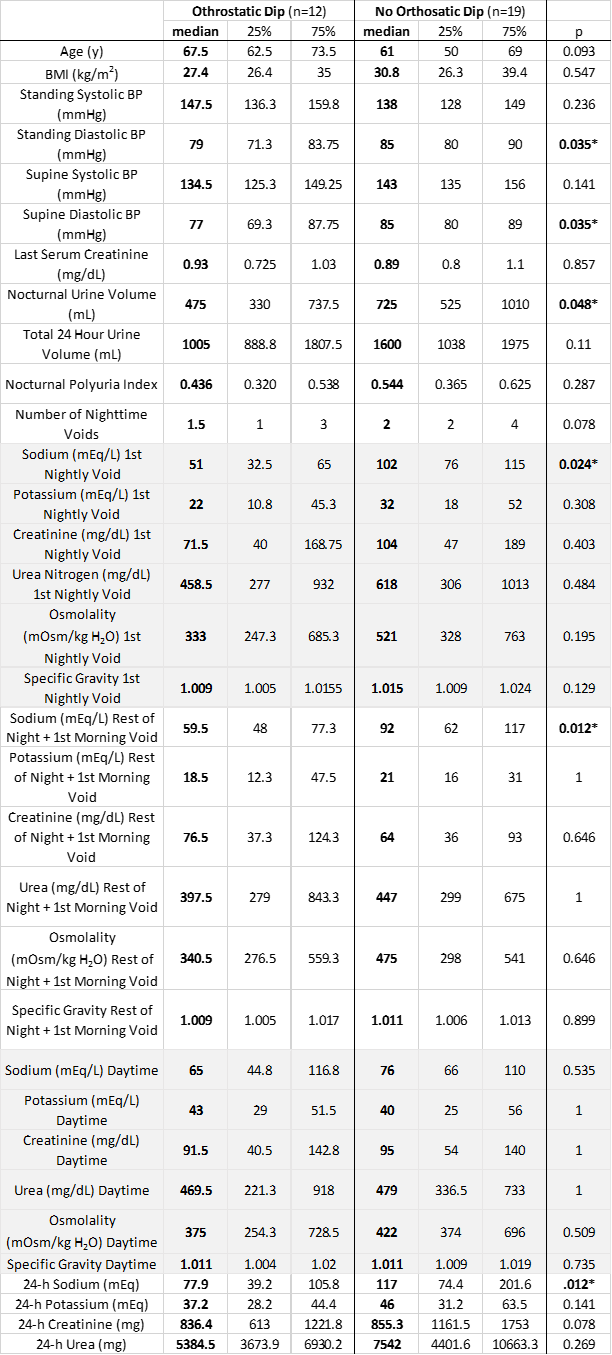
Introduction: There are numerous comorbidities correlated with nocturia, among the most clinically significant of these being hypertension. Elevation in blood pressure (BP) suppresses serum arginine vasopressin levels, lending evidence to the idea that hypertension is associated pathophysiologically with nocturnal polyuria, which may cause nocturia. Greater nighttime BP and lower nocturnal BP dipping have been associated with more frequent nocturnal voiding. The aim of this study is to assess the impact of non-dipping orthostatic BP in hypertensives on nighttime and daytime urine production. Methods: Participants with a diagnosis of essential hypertension had in-office supine and standing BP recordings and completed 24-hour urine collection and voiding diaries. Urine was collected in 3 containers; one for the first nighttime void, a second for all subsequent nighttime voids and first morning void, and a third for all daytime voids. Participants whose systolic BP decreased with supine positioning were placed in the orthostatic dip group, and participants whose systolic BP increased or was unchanged upon supine positioning were placed in the no orthostatic dip group. Results: There were 12 (9 female) individuals in the dipping group and 19 (13 female) in the non-dipping group. The non-dipping group tended to produce greater volumes of urine both day and night, and had greater 24-hour urine sodium excretion. The sodium concentration of the first nighttime void was significantly higher in the non-dipping group (median: 102; IQR: 76-105 mEq/L) than the dipping group (median: 51; IQR: 32.5 - 65 mEq/L) (p = .024). This urine sodium concentration for the remainder of the night was significantly higher in the non-dipping group (median: 92; IQR: 62 - 117 mEq/L) than the dipping group (median: 59.5; IQR: 48-77.25 mEq/L) (p = .012). Subjects in the non-dipping group were 79% more likely to experience 2 or more nighttime voids compared to the dipping group (RR: 1.79; 95% CI: 1 – 3.2; p = .052). Conclusions: An in-office BP measurement that does not dip with supine positioning is associated with more frequent nighttime voiding as well as higher urine concentrations of sodium in both early and late-night voids. SOURCE OF Funding: None