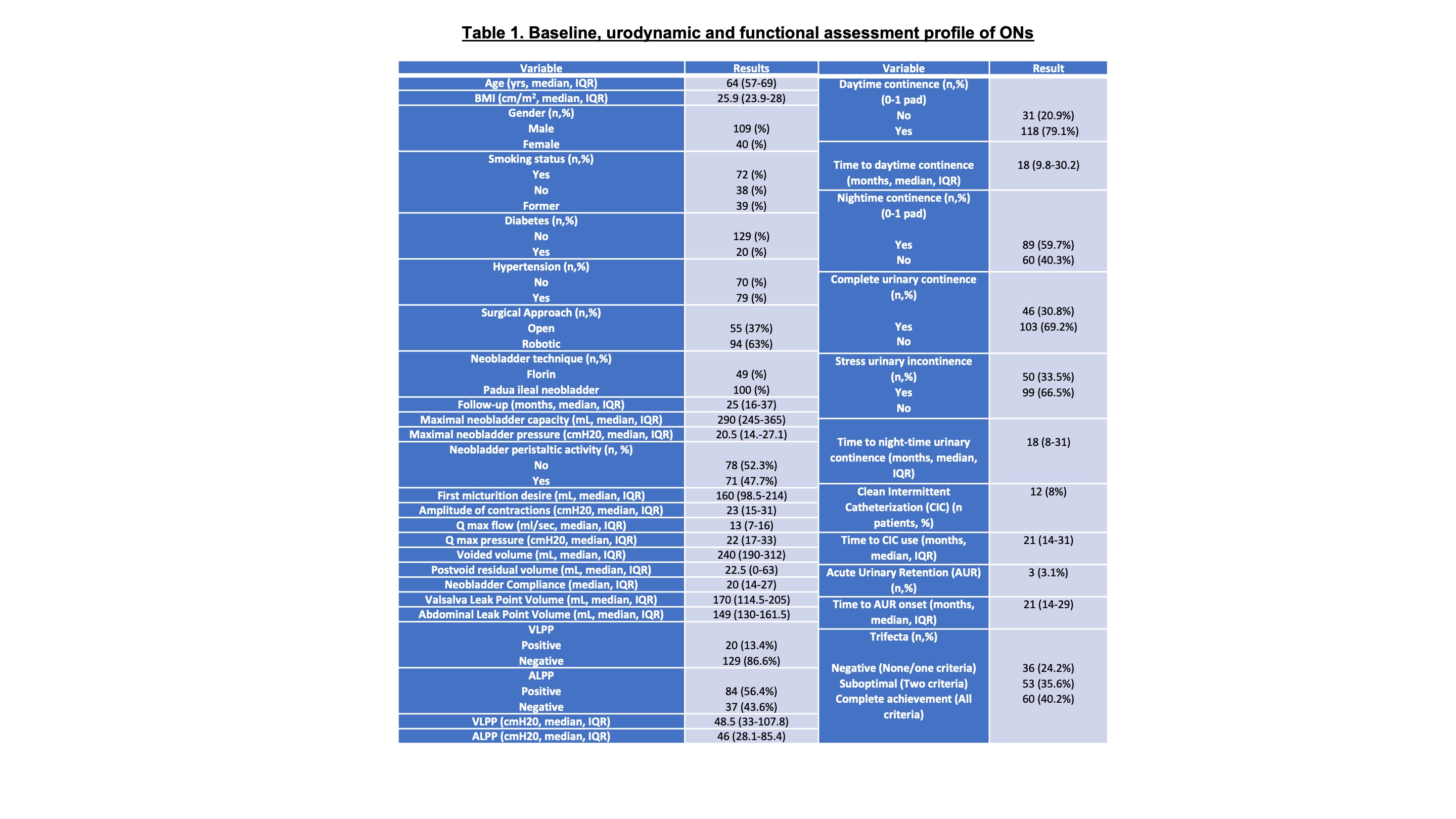
Introduction: Despite robot-assisted radical cystectomy (RARC) is gathering a growing interest over open radical cystectomy (ORC), a comprehensive system for standardizing quality of functional outcomes of ileal orthotopic neobladders (iONs) is still unavailable. In this study we propose a novel urodynamic trifecta for both ORC and RARC that summarizes iONs outcomes regardless the surgical technique used and predicts continence outcomes Methods: Between June 2017 and October 2022 two prospective, institutional review board approved, radical cystectomy datasets were matched and queried for “iONs” “and “urodynamic evaluation” (n=149). Urodynamic assessment was performed between 6 and 9 months after surgery. Trifecta was defined as the coexistence of: cystometric capacity = 250 cc; neobladder compliance = 35 cmH20 ; negative Valsalva and abdominal leak point pressure testing. Simultaneous achievement of only two of the presented criteria was considered a suboptimal result. Logistic regression analyses were built to identify predictors of daytime and night-time urinary continence. For all analyses, a two-sided p<0.05 was considered significant Results: Overall, at a median follow-up of 25 months (IQR 16-37), 149 patients achieved a complete urodynamic evaluation. In the current series, the complete trifecta rate was 40.2% while a suboptimal trifecta achievement was observed in 35.6% of patients. Baseline, urodynamic and continence data are shown in Table 1. At univariable logistic regression analysis, male gender (OR 2.4; 95% CI 1.04-5.53; p=0.039) and complete trifecta achievement (OR 7.01; 95% CI 1.99-24.6; p=0.002) were predictors of daytime urinary continence while complete trifecta achievement (OR 8.18, 95% CI 2.99-22.3; p<0.001) was the only predictor of night-time urinary continence. On multivariable analysis, complete trifecta achievement was the only independent predictor of daytime (OR 7.29, 95% CI 2.05-25.9) and night-time (OR 8.13; 95% CI 2.94-22.4) urinary continence, respectively (each p<0.003) Conclusions: This novel urodynamic trifecta for iONs is based on standardized parameters and seems to be predictor of either daytime or night-time urinary continence at a mid-term follow-up. Satisfactory continence outcomes may be also expected when a suboptimal trifecta rate is achieved SOURCE OF Funding: None