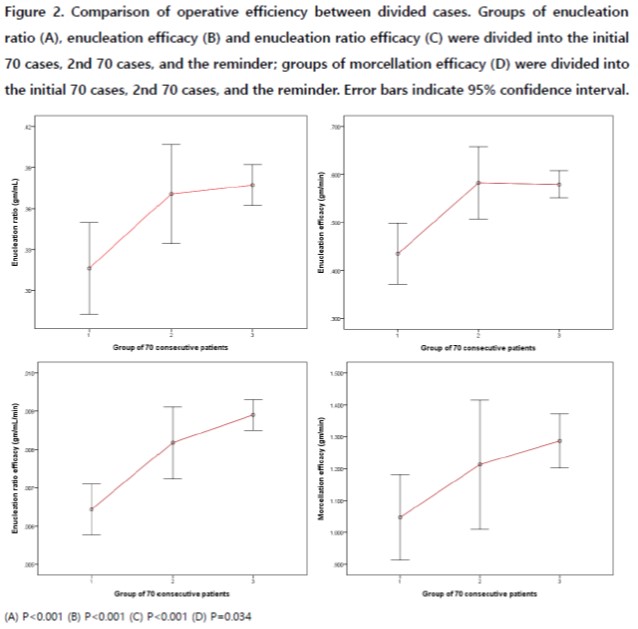
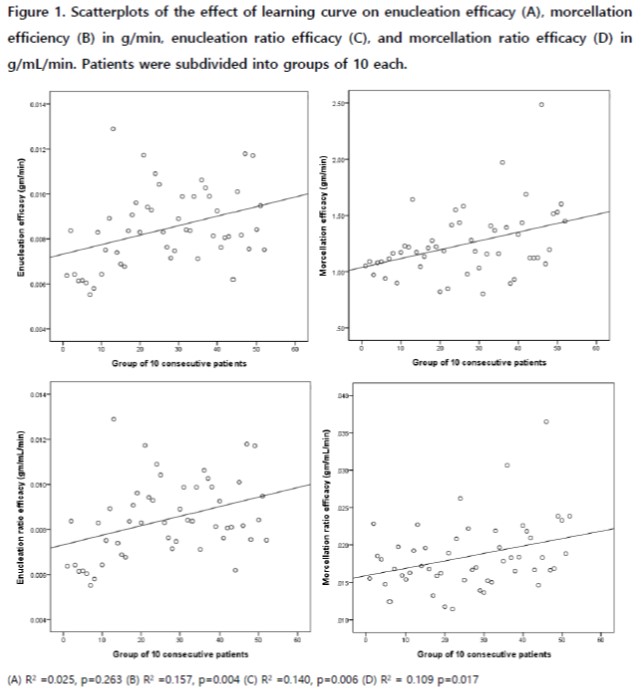
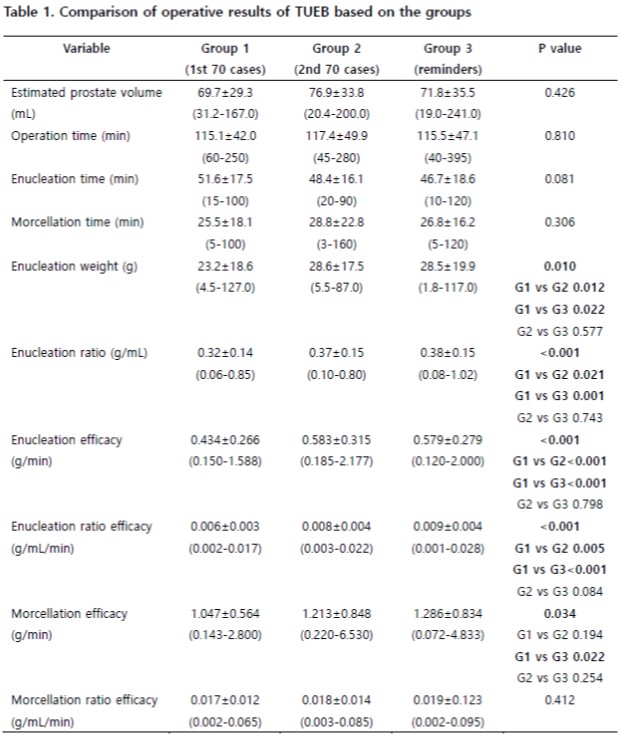
Introduction: Transurethral enucleation with bipolar (TUEB) using spatula loop is one of endoscopic enucleation methods for the surgical treatment of benign prostatic hyperplasia, and has more advantages in intraoperative hemostasis and specimen removal after enucleation. We evaluated the learning curve and efficacy of the enucleation using a single-surgeon experience. Methods: Five hundred and seventeen (n=517) consecutive patients who underwent TUEB from August 2018 to March 2022 by a single surgeon were enrolled. Perioperative clinical variables, including enucleation time, morcellation time, enucleation ratio (enucleation weight/evaluated prostate volume), enucleation efficiency (enucleated weight/enucleation time), and morcellation efficiency (enucleated weight/morcellation time) were analyzed (Fig. 1). The operative parameters were compared according to three groups; group 1 (initial 70 patients), group 2 (the second 70 patients) and group 3 (the reminders). Results: Mean enucleation time, morcellation time, and enucleation ratio were 47.6 min (range, 10-120 min), 26.9 min (range, 3-160 min), and 0.37 (range, 0.06-1.02), respectively. In terms of operative efficacy, enucleation efficacy was 0.56 g/min (range, 0.12-2.18 g/min) and morcellation efficacy was 1.24 g/min (range, 0.1-6.5 g/min). Table 1 shows comparison of operative results of TUEB based on the groups. Concerning the learning curve, enucleation ratio, enucleation efficacy and enucleation ratio efficacy was at plateau phase, improving by 34% after 70 cases (all p<0.001; Fig. 2). Conclusions: The enucleation efficacy of TUEB using spatula loop reached stable stage within 70 procedures. Further analyses on the learning curve may be necessary in respect of long-term outcome or rate of complication. SOURCE OF Funding: None