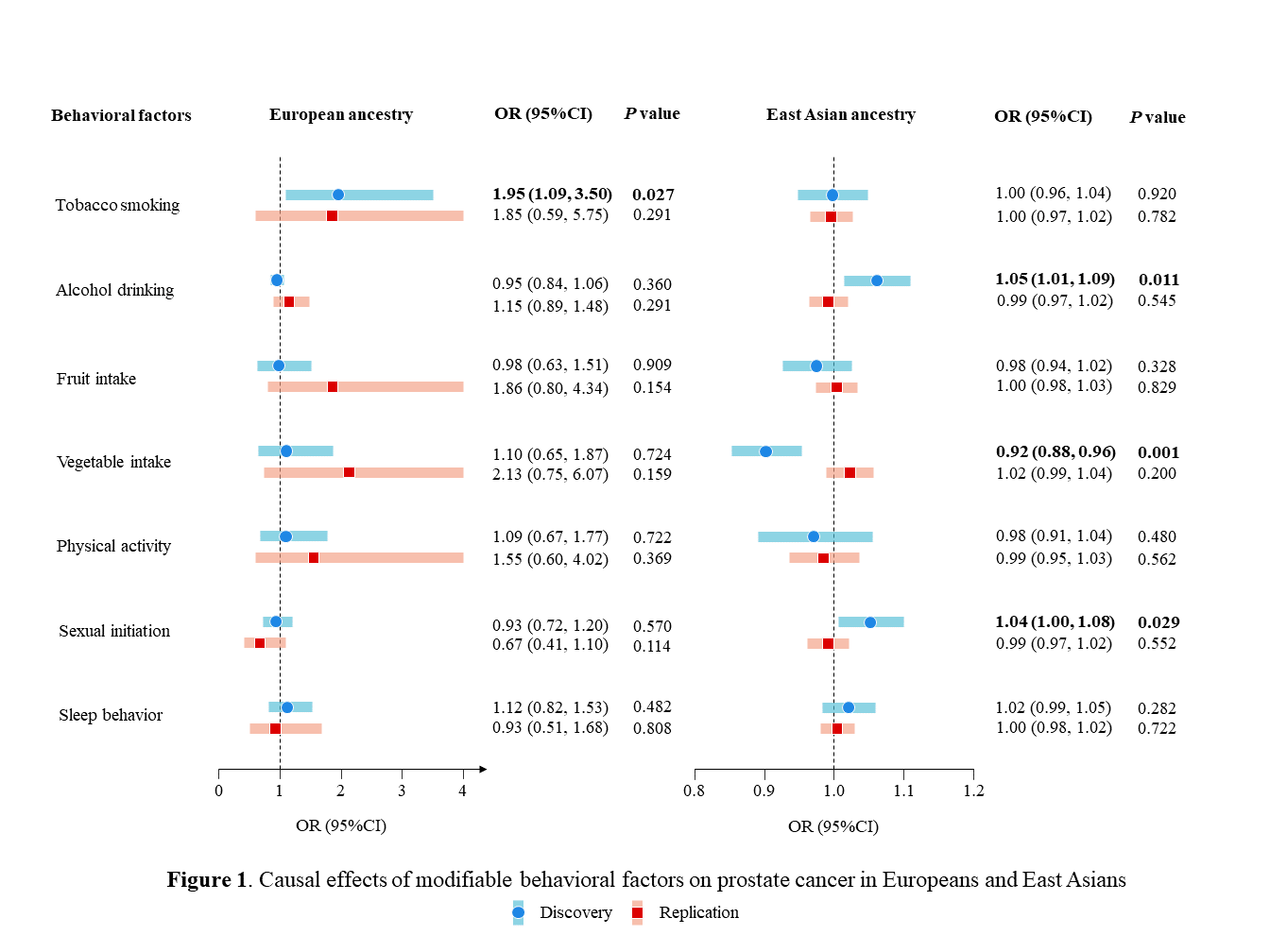
Introduction: Early evidence is disputable for the effects of modifiable lifestyle behaviors on prostate cancer (PCa) risk. No research has appraised such causality in different ancestries using a Mendelian randomization (MR) approach. The study aims to infer the causality between common lifestyle behaviors and PCa risks in the European and East Asian populations. Methods: Two-sample univariable and multivariable MR methods were applied to evaluate the causal relationship between seven types of modifiable lifestyle behaviors and PCa risk, based on genome-wide association studies (GWAS) from PRACTICAL and GAME-ON/ELLIPSE consortia for Europeans (79,148 PCa cases and 61,106 controls), and ChinaPCa consortium for East Asians (3,343 cases and 3,315 controls). Replication was performed using FinnGen (6,311 cases and 88,902 controls) and BioBank Japan data (5,408 cases and 103,939 controls). Results: Tobacco smoking was identified to cause PCa in Europeans (odds ratio [OR]:1.95, 95% confidence interval [CI]:1.09-3.50, P=0.027 per standard deviation increase in the lifetime smoking index). Alcohol drinking (OR:1.05, 95%CI:1.01-1.09, P=0.011) and delayed sexual initiation (OR:1.04, 95%CI:1.00-1.08, P=0.029) were identified to be risk factors while cooked vegetable consumption (OR:0.92, 95%CI:0.88-0.96, P=0.001) to be a protective factor of PCa in East Asians (Figure 1). Conclusions: Our findings broaden the evidence base for the spectrum of PCa risk factors in different ethnicities, and provide insights into behavioral intervention for PCa in different settings. SOURCE OF Funding: This work was in supported by grants from National Natural Science Foundation of China (Grant No. 81972645), Innovative research team of high-level local universities in Shanghai, Shanghai Youth Talent Support Program, intramural funding of The University of Hong Kong to Dr. Rong Na, and Shanghai Sailing Program (22YF1440500) to Dr. Da Huang. All the funders had no role in study design, data collection, data analysis, interpretation, and writing of the report.