Session: MP77: Prostate Cancer: Epidemiology & Natural History II
MP77-13: Outpatient versus Inpatient Robotic Assisted Radical Prostatectomy: Complications, Time Driven Activities Based Costing and Patient Satisfaction
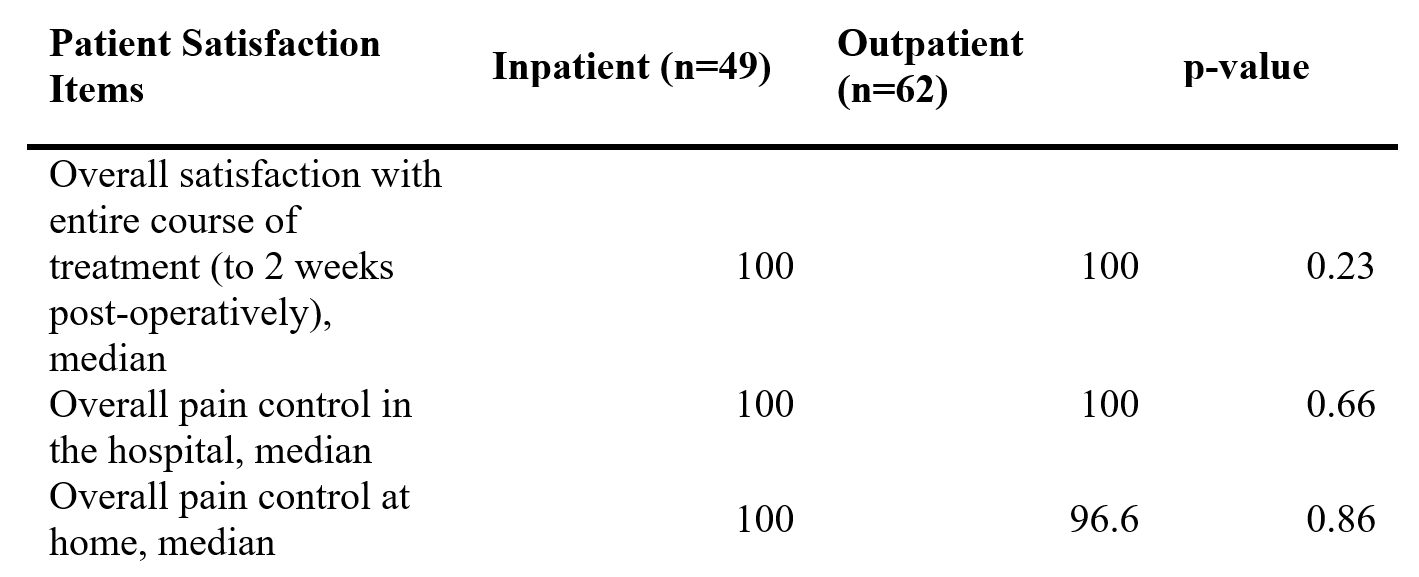
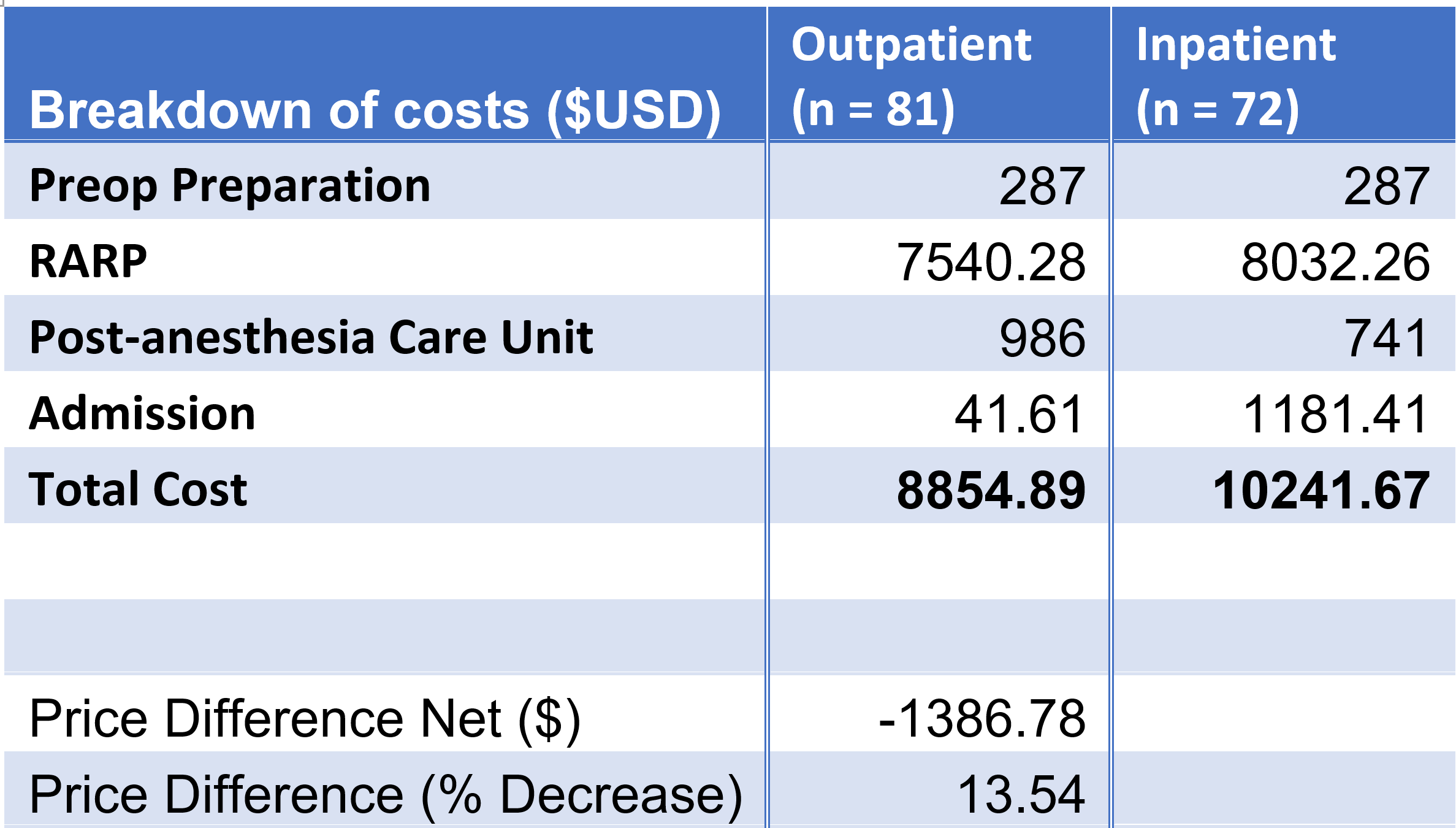
Introduction: Radical prostatectomy lengths of stay decreased with ketorolac analgesia and adoption of robotic assisted radical prostatectomy (RARP). During the COVID-19 pandemic, the transition to outpatient RARP freed up critically needed hospital beds. The healthcare cost reduction afforded by the shift to outpatient RARP and its effect on patient satisfaction has yet to be explored. We compared healthcare costs, patient satisfaction and complications for outpatient vs. inpatient RARP. Methods: We identified and compared a series of consecutive RARP performed as outpatient vs. inpatient and determined the capacity cost rate for every resource, including personnel, equipment, and space. After the lifting of hospital restrictions, men were given the option of inpatient vs. outpatient RARP. We also administered a validated Patient Satisfaction Outcome Questionnaire (PSOQ) post-operatively and compared median scores in perceived outcomes and satisfaction. A time-driven activity-based costing (TDABC) analysis was applied to compare the total costs of care for RARP performed. Finally, we captured complications within 30 days of surgery using the Clavien-Dindo classification. We used multivariable regression to adjust for age, race, BMI, and ASA classification to assess the impact of outpatient vs. inpatient RARP on complications. Results: There were no significant differences in patient characteristics for outpatient (n=145) vs. inpatient (n=80) RARP. When given the choice, 86.6% of men elected for outpatient vs. inpatient RARP. Outpatient RARP netted a $1387 (13.5%) cost reduction compared to inpatient RARP. There were no significant differences in outpatient vs. inpatient median satisfaction survey scores or complications within 30 days (11.0% vs. 11.3%, p=0.961). Conclusions: Outpatient RARP can be safely performed, with similar outcomes and compared to inpatient RARP. Outpatient RARP has significantly lower costs compared to inpatient RARP while maintaining similar patient satisfaction outcomes. SOURCE OF Funding: Jim C. Hu receives research support from the Frederick J. and Theresa Dow Wallace Fund of the New York Community Trust. Jim C. Hu also receives salary support from NIH R01 CA241758, R01 CA259173, R01 CA273031, PCORI CER-2019C1-15682 and CER-2019C2-17372 and a Prostate Cancer Foundation Challenge Award. The remaining authors report no further disclosures related to this work.