IRCCS San Raffaele Scientific Institute, Milan, Italy
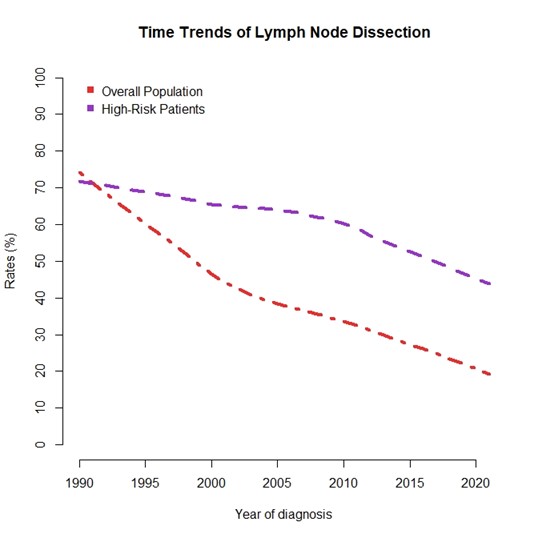
Introduction: The role of lymph node dissection (LND) in renal cell carcinoma (RCC) patients is still controversial. Despite several studies showed no survival benefits of LND in RCC, performing LND may be still important for staging purposes, in the light of new promising adjuvant treatments in locally advanced disease. Thus, we aimed at assessing the trend of LND over the last 30 years. Methods: We relied on a prospectively maintained database including 2,880 patients treated with radical (RN) or partial nephrectomy (PN) for non-metastatic RCC at a high-volume centre between 1990 and 2021. High-risk disease was defined as patients harbouring pT3-4, and/or pN1 and/or Fuhrman grade 3-4 RCC. Temporal trend analyses using estimated annual percentages changes (EAPC) were performed. Multivariable logistic regression analyses (MVA) tested the effect of year of surgery on LND, after adjusting for age at surgery, clinical tumor size, clinical tumor stage, clinical nodal stage, type of surgery and surgical approach. Results: Overall, 2,880 patients underwent either PN or RN for RCC. Of these, 1,135 (39%) underwent LND, but only 161 (5.6%) showed confirmed pN invasion. Patients treated with LND were younger (61 vs. 63 yrs; p<0.001), more frequently symptomatic (51 vs. 24%; p<0.001), with higher clinical size (7 vs. 3.8 cm; p<0.001) and higher rates of suspicious cN+ disease (25 vs. 6.8%; p<0.001). Time trends analyses revealed a reduction in LND over time, both in the overall population (from 74 to 33%; EAPC: -3.7%; P<0.001) and in high-risk patients (from 72 to 50%; EAPC: -1.4%; P<0.001). Moreover, the median number of LNs removed also decreased over time, from 6 [Interquartile range (IQR): 3-5] to 2 (IQR: 1-4; P<0.001). At MVA, patients undergoing surgery for RCC in the most recent years were less likely to receive LND (OR: 0.96; 95%CI 0.95-0.98; p<0.001). Conclusions: Over the last 30 years, the rates of LND performed in RCC patients significantly decreased over time. Such trend was also shown in high-risk patients, regardless of tumor characteristics or surgical approach. Given the importance of LND for staging purposes, the observed phenomenon may increase the proportion of patients with unknown locally advanced disease at time of surgery and their inclusion in protocols for adjuvant therapies. SOURCE OF Funding: None