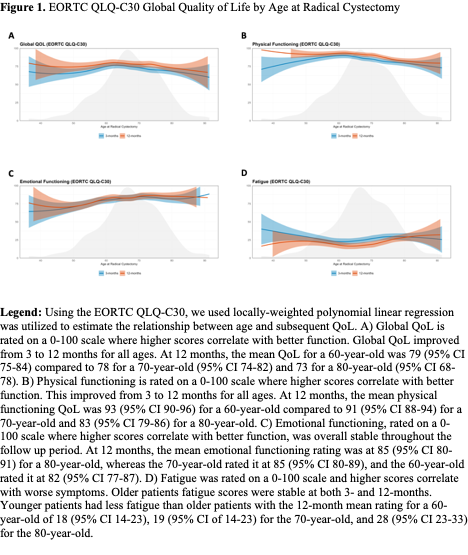
Introduction: We previously documented the changes and recovery of Health Related Quality of Life (HR-QoL) after Radical Cystectomy (RC), the gold standard for high-risk invasive bladder cancer. The concern that elderly patients may have a poor QoL after RC may lead both patients and clinicians to avoid definitive surgery despite its oncologic benefits. Our objective was to examine post-RC HR-QoL and how it changes with increasing age. Methods: To better characterize HR-QoL impacts of RC, we conducted a prospective study with 14 validated patient reported outcome measures of interest to invasive bladder cancer patients. Herein, we describe HR-QoL recovery after RC by patient age at surgery. Locally-weighted polynomial linear regression was utilized to estimate the relationship between age and subsequent QoL. QoL measures were assessed at 3 and 12 months after surgery to assess early and later effects on HRQOL and maximize the number of evaluable patients. Results: We did not find any significant (>10 points) age-associated differences on the EORTC QLQ-C30 domains, which are rated on a 0-100 scale (i.e., global QoL, role functioning, cognitive functioning). (Figure 1) Of the differences that approached clinical significance, at 12 months, older patients reported slightly worse physical functioning and fatigue, with a mean physical functioning QoL score of 83 (95% CI 79-86) for a 80-year-old compared to 93 (95% CI 90-96) for a 60-year-old and a mean fatigue score of 28 (95% CI 23-33) for a 80-year-old compared to 18 (95% CI 14-23) for a 60-year old. Using the EORTC BLM-30, we found no major age-related differences in body image or urostomy issues, and a moderate difference in urinary functioning, which is only rated for continent diversions. Regardless of the age at RC, the satisfaction with life and mental health scores are stable at the 12-month time point. Conclusions: This prospective study demonstrates that older patients selected for RC do not report major decreases to HR-QoL after surgery compared to younger patients. While changes in activity levels and fatigue are mildly greater in the oldest group, overall QoL recovered in a similar fashion to younger patients. Geriatric patients selected for RC have a similar QoL post-RC compared to their younger counterparts and should not be counseled against RC based on QoL concerns alone. SOURCE OF Funding: This work was supported by the Sidney Kimmel Center for Prostate and Urologic Cancers, the National Cancer Institute Cancer Center Core grant number P30-CA008748, Ruth L. Kirschstein National Research Service Award T32CA082088, and the Pin Down Bladder Cancer Fund.