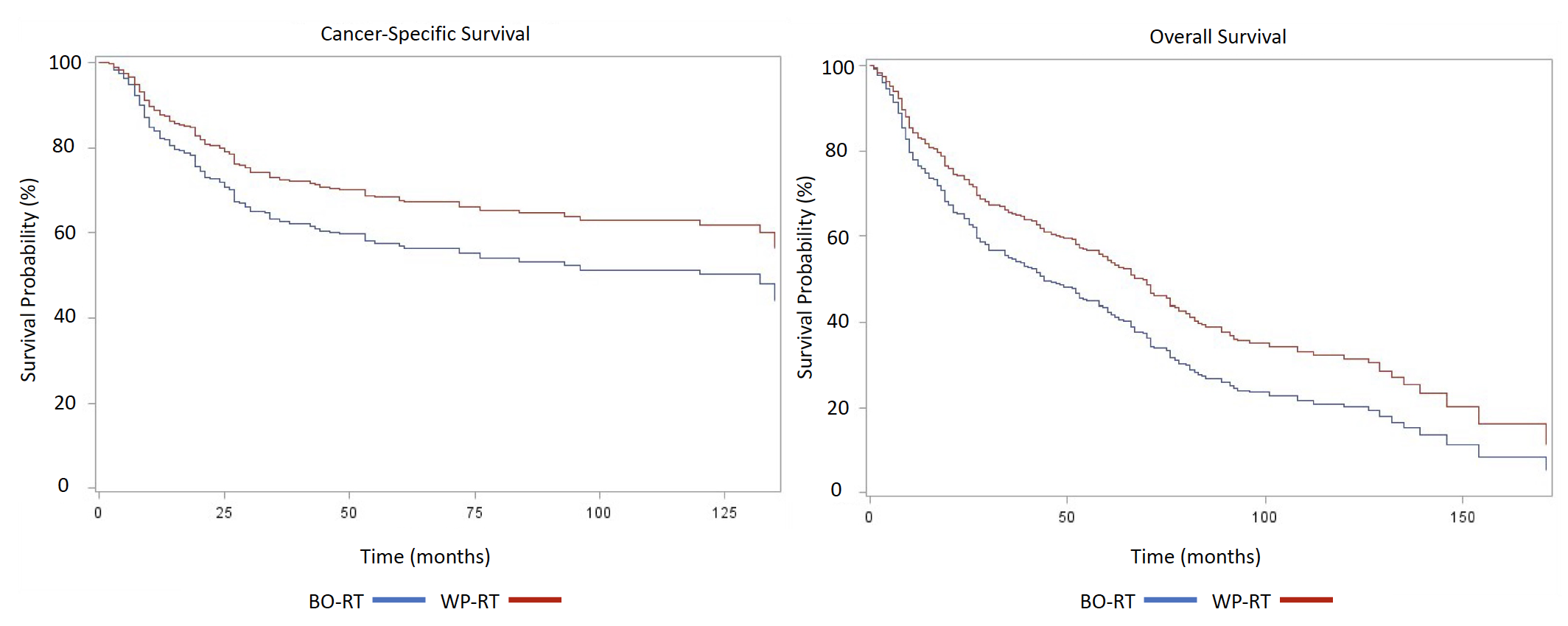
Introduction: Pelvic lymph node irradiation is still under debate for patients with muscle-invasive bladder cancer (MIBC) planned for curative-intent radiation-based therapy (RT). Previous studies suggested bladder-only (BO)-RT was associated with non-inferior oncological outcomes compared to whole-pelvis (WP)-RT. In this study, we sought to evaluate the impact of the radiation volume (BO-RT vs. WP-RT) on main oncological outcomes in patients with MIBC. Methods: Patients with urothelial MIBC (cT2-4aN0-2M0) who underwent curative RT at 10 academic centers across Canada were included. Patients were divided into two groups based on the RT volume: WP-RT vs. BO-RT. Inverse probability of treatment weighting (IPTW) and absolute standardized differences (ASDs) were used to balance baseline covariates across treatment groups. Regression models were used to assess the impact of the RT volume on the rates of complete response (CR) to treatment, cancer-specific survival (CSS), and overall survival OS while adjusting for potential confounding variables in the weighted cohorts. Results: A total of 599 patients were analyzed, out of whom 369 (61.6%) underwent WP-RT. Patients in the WP-RT group were younger (mean age 73.2 vs. 77.4; ASD 0.41), and more likely to have an Eastern Cooperative Oncology Group performance status (ECOG PS) of 0-1 (82.1% vs. 73.5%; ASD 0.21), clinical node-positive disease (12.5% vs. 2.2%; ASD 0.40), and lymphovascular invasion (26.3% vs. 16.1%; ASD 0.25), compared to BO-RT. In addition, WP-RT patients were more commonly treated with neoadjuvant chemotherapy (20.9% vs. 10.4%; ASD 0.29) and concurrent chemotherapy (76.7% vs. 56.5%; ASD 0.44), compared to BO-RT. In the IPTW cohort, all pre-treatment covariates were well balanced across groups (ASDs < 0.10). In multivariable analysis, WP-RT did not impact CR rates post-RT (OR 1.14; p=0.526) but was associated with both CSS (HR 0.66; p=0.016) and OS (HR 0.68; p=0.002), independently of other prognostic factors. Direct adjusted survival functions are shown - figure 1. Conclusions: Our study demonstrated a significant survival benefit with the use of WP-RT compared to BO-RT in patients with MIBC treated with curative intent. Additional randomized controlled trials are needed to confirm our findings. SOURCE OF Funding: None

.jpg "Ronald Kool, MD photo")