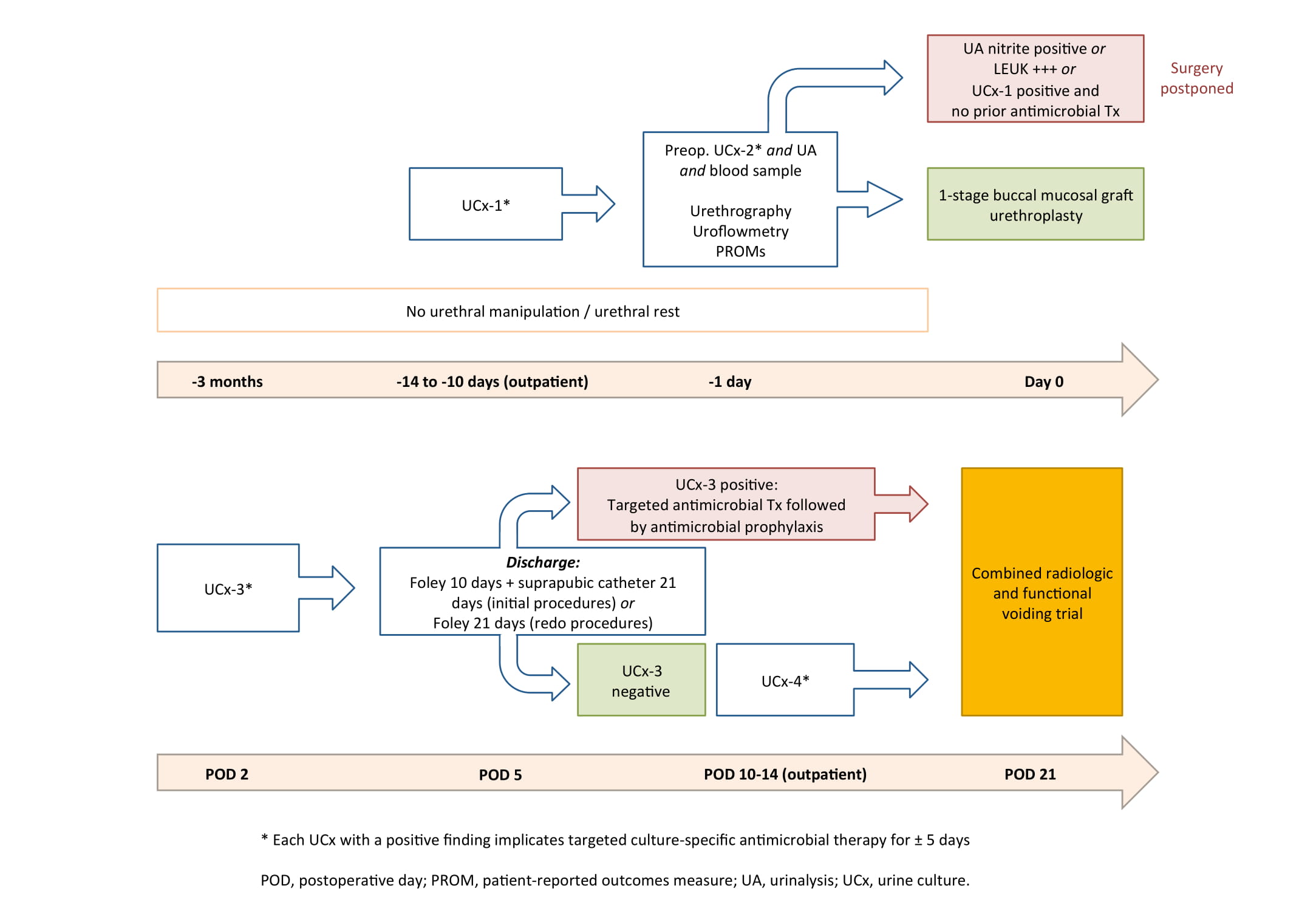
Introduction: There is a huge variability of antimicrobial administration in the perioperative urethroplasty setting. We aimed to validate our institutional standardized protocol for testing and culture-specific treatment on three sequential endpoints to improve antibiotic stewardship (ABS). Methods: Urethroplasty patients are subjected to our SOP for urinalysis and antimicrobial Tx (Figure 1). Men undergoing bulbar substitution urethroplasty between 2009-16 were stratified by urine culture (UCx) result at the time of surgery (sterile vs. nonsterile). We performed quantitative and qualitative exploration of the UCxs, and evaluated the microbial spectrum. The ability of our standardized algorithm to improve ABS over the perioperative course was tested by three endpoints: (A) immediate (2nd UCx on POD2), (B) short-term (21-day infectious complications), and (C) long-term (retreatment-free survival [RFS]). Statistical analyses included bivariate comparisons, Kaplan-Meier estimators compared RFS between the groups. Multivariable Cox regression was used to evaluate the independent effect of UCx status at the time of surgery on RFS. Results: Of 374 men, 235 (63%) had a sterile and 139 (37%) a nonsterile preoperative UCx. In the latter, gram-positive cocci (63%) and enterobacteriaceae (22%) were the most frequent microbes. Nonsterile UCx was more common in patients with catheter (38 vs. 21%; p<0.001). The number of patients with sterile UCx at the time of surgery (63%) was significantly improved to 82% at POD2 (p < 0.001). There were 16 infectious complications (4.3%; 14 urinary tract infections and two wound infections) with no difference between patients with sterile vs. nonsterile UCx (p=0.6). At a median follow-up of 29 mo, there was no difference in RFS (16%) between patients with sterile vs. nonsterile UCx (p=0.3). Positive UCx was no predictor of recurrence in Cox regression analysis after adjusting for age, catheter, prior stricture treatment, and graft length (p=0.5). Conclusions: A standardized perioperative protocol such as the one introduced improves ABS through frequent testing and culture-specific treatment. This is crucial in avoiding unnecessary antimicrobial treatment, and reducing infectious events and adverse effects of a positive UCx on long-term stricture recurrence. SOURCE OF Funding: n/a