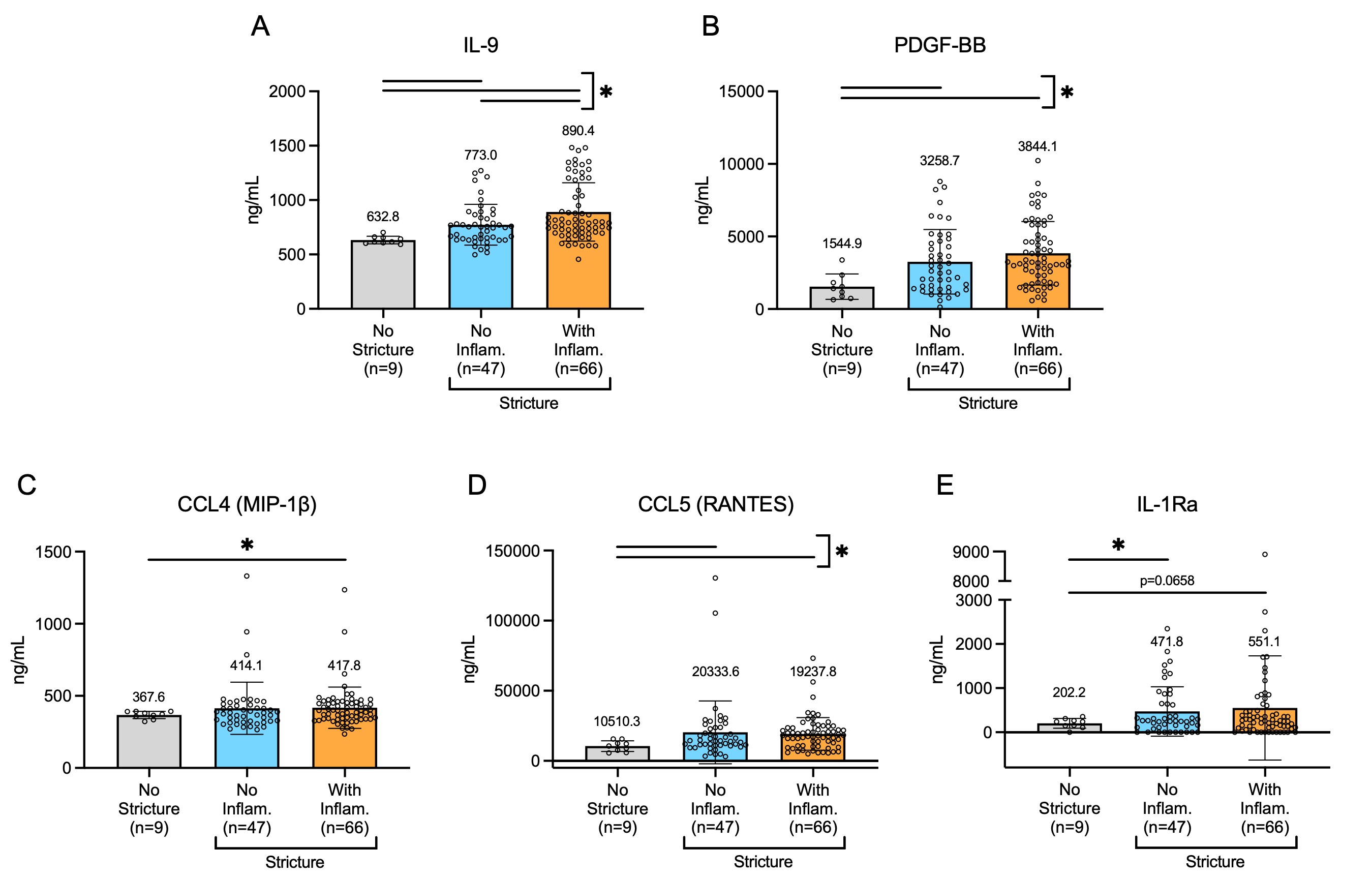
Introduction: Anterior urethral stricture disease (aUSD) is a heterogeneous condition with complex pathophysiology. Little is known about systemic factors predisposing to or resulting from stricture formation. To address this gap in knowledge, we assessed levels of 27 cytokines in serum from patients with and without strictures. We hypothesized that patients with strictures would have distinct serum cytokine profiles relative to controls. Methods: Five centers prospectively enrolled patients into an NIDDK-funded study evaluating local and systemic inflammatory patterns in aUSD. Subjects underwent standard urethroplasty per surgeon routine and tissue was sent to a centralized tissue repository. Serum was collected prior to stricture repair. Levels of 27 cytokines were assessed by ELISA. H&E-stained sections of stricture tissue were examined by a single, blinded pathologist and evaluated for the presence or absence of inflammation. Results: Patient-matched serum and stricture specimens were collected from 113 subjects. Strictures were grouped based on the presence or absence of inflammation (n=66 and n=47, respectively). Serum from age-matched patients without urethral strictures was used as a control (n=9). Four pro-fibrotic cytokines were significantly increased in patients with strictures: interleukin-9 (IL-9), platelet derived growth factor-BB (PDGF-BB), C-C Motif Chemokine Ligand 4 (CCL4), and C-C Motif Chemokine Ligand 5 (CCL5) [A-D]. Only IL-9 levels differed by stricture inflammatory pattern (890.4 ng/mL vs 773.0 ng/mL, p<0.05). In addition to higher levels of pro-fibrotic cytokines, interleukin-1 receptor antagonist (IL-1Ra), which has immunosuppressive functions, was increased in patients with strictures [E]. Conclusions: Patients with aUSD have unique serum cytokine profiles relative to age-matched controls. Four of these cytokines, IL-9, PDGF-BB, CCL4, and CCL5 have previously been implicated in promoting fibrosis and scarring in humans and in animal models. IL-1Ra has immunosuppressive functions and may be increased to maintain homeostasis. Further studies are needed to determine if these cytokines are increased as a result of the stricture or if their levels are higher at baseline, predisposing patients to stricture formation. SOURCE OF Funding: NIDDK 1R21DK115945-01