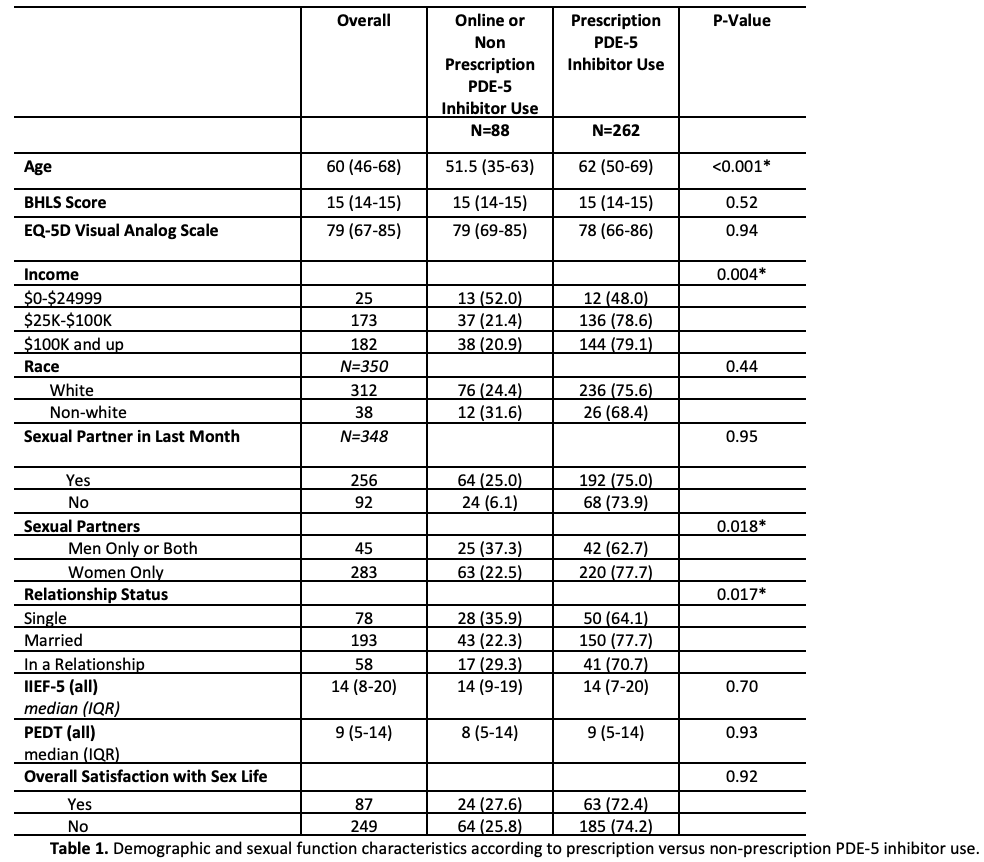
Introduction: PDE-5 inhibitors (PDE-5i) are the mainstay of medical management for erectile dysfunction but do carry risk. Increased availability of these medicines from sources outside of a physician’s office may present risks to patients due to incomplete counseling or medication reconciliation and may also expose individuals to counterfeit medication. We sought to characterize associations of demographics, sexual function, and sexual orientation with PDE-5i obtained from non-prescription means. Methods: Adult males were recruited through a national registry of volunteers (ResearchMatch) to participate in an online survey. We assessed PDE-5 inhibitor use and the medications’ source of within the last year. Demographic, sexual partner, and validated scores for erectile function (IIEF-5) and ejaculatory function (PEDT) were obtained. Logistic regression analyses were performed to identify associations with obtaining non-prescription PDE-5 inhibitors. Results: Of the 1033 men who completed the survey, 348 reported using PDE-5i in the past year (Table 1) with 88 (25.1%) obtaining PDE-5i from a non-prescription source. Men obtaining non-prescription PDE-5i tended to be younger (median age 51.5 vs. 62, p<0.001) than those obtaining it with a standard prescription. Sexual function characteristics by IIEF and PEDT scores were similar between groups. Men who have sex with men (MSM) were nearly twice as likely to have obtained PDE-5i from a non-prescription source (37.3 vs. 22.5%, p=0.018). Married men were less likely than single men to purchase PDE-5i from a non-prescription source (22.3 vs. 35.9%, p=0.017). On multivariable analysis, only older age was associated with decreased odds of obtaining PDE-5i from an online or non-prescription source (OR 0.97, 0.95-0.98, p<0.001). Conclusions: In this large, community-based study of adult men, we found that a quarter of PDE-5i users had obtained medication without seeing a physician. We found that younger men and men who have sex with men (though not significant on multivariable analysis) were more likely to obtain these medicines from alternative sources. While these medicines are typically well tolerated, medication obtained from unreliable sources is more likely to be counterfeit and may place individuals at higher risk for adverse events. SOURCE OF Funding: N/A