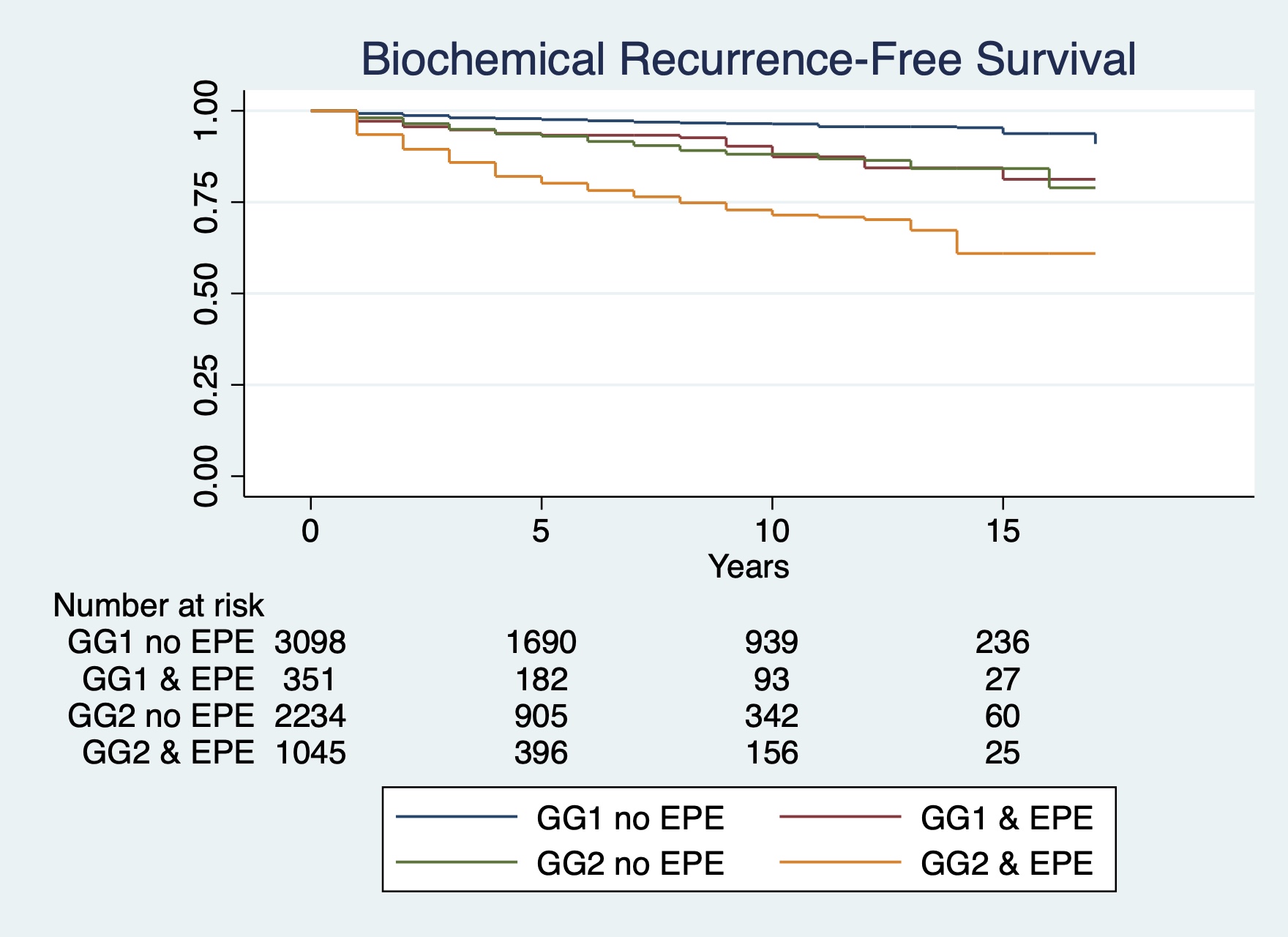
Introduction: Grade group 1 (GG1) prostate cancer (PCa), defined as Gleason 3+3=6 disease, is associated with biological and clinical indolence. Hence, these cancers are amenable to active surveillance (AS) strategies. Despite their exceedingly low risk of metastatic potential, some GG1 tumors have demonstrated the ability to invade locally beyond the prostatic capsule. While extraprostatic extension (EPE; pT3a stage) independently carries a poorer prognosis compared to encapsulated tumors, the oncologic significance of EPE in the setting of pure GG1 disease remains poorly characterized. Therefore, we sought to examine the impact of EPE on biochemical recurrence (BCR) and survival outcomes in men with GG1 disease treated with radical prostatectomy. Methods: We reviewed our IRB-approved, institutional database of patients who underwent radical prostatectomy for PCa between 2005 and 2022. Patients were categorized into four groups based on final pathology: GG1 without EPE, GG1 with EPE, GG2 (Gleason 3+4=7) without EPE and GG2 with EPE. Kaplan-Meier curves and Fine-Gray competing risk models were used to examine the relationship between disease group and BCR-free, metastasis-free, cancer-specific, and overall survival. BCR and metastasis-free models were adjusted for age, race, preoperative PSA, surgical margin status, year of surgery, and receipt of adjuvant radiation. Results: The final analytic cohort consisted of 6,751 men, of whom 353/3,458 (10.2%) with GG1 disease had EPE. Median follow up was 4 years. BCR occurred in 474/6,751 (7.0%) patients. BCR-free survival was significantly worse for patients with GG1 and EPE (hazard ratio [HR] = 1.9; 95% CI: 1.3-3.1) compared to patients with GG1 and no EPE (Figure 1). Metastasis occurred in 30/6,751 (0.4%) patients. Metastasis-free survival was significantly worse for patients with GG1 and EPE (HR = 10.9; 95% CI: 1.2-101.5) compared to patients with GG1 and no EPE. No difference was observed in cancer-specific or overall survival among patients with GG1 PCa in the presence or absence of EPE. Conclusions: Patients with GG1 PCa and EPE at prostatectomy exhibit worse BCR and metastasis-free survival compared to GG1 patients without EPE. Predicting EPE among patients with pure GG1 disease is critical to better inform personalized strategies for AS or active treatment in this population. SOURCE OF Funding: None

.jpg "Michael Rezaee, MD photo")