Session: PD45: Stone Disease Surgical Therapy (including ESWL) IV
PD45-05: Turning up the HEAT: Thermal Profile of Holmium:YAG (HL) and Thulium (TLF) Laser Lithotripsy in a Pelvicalyceal System (PCS) Anatomic Hydrogel Model
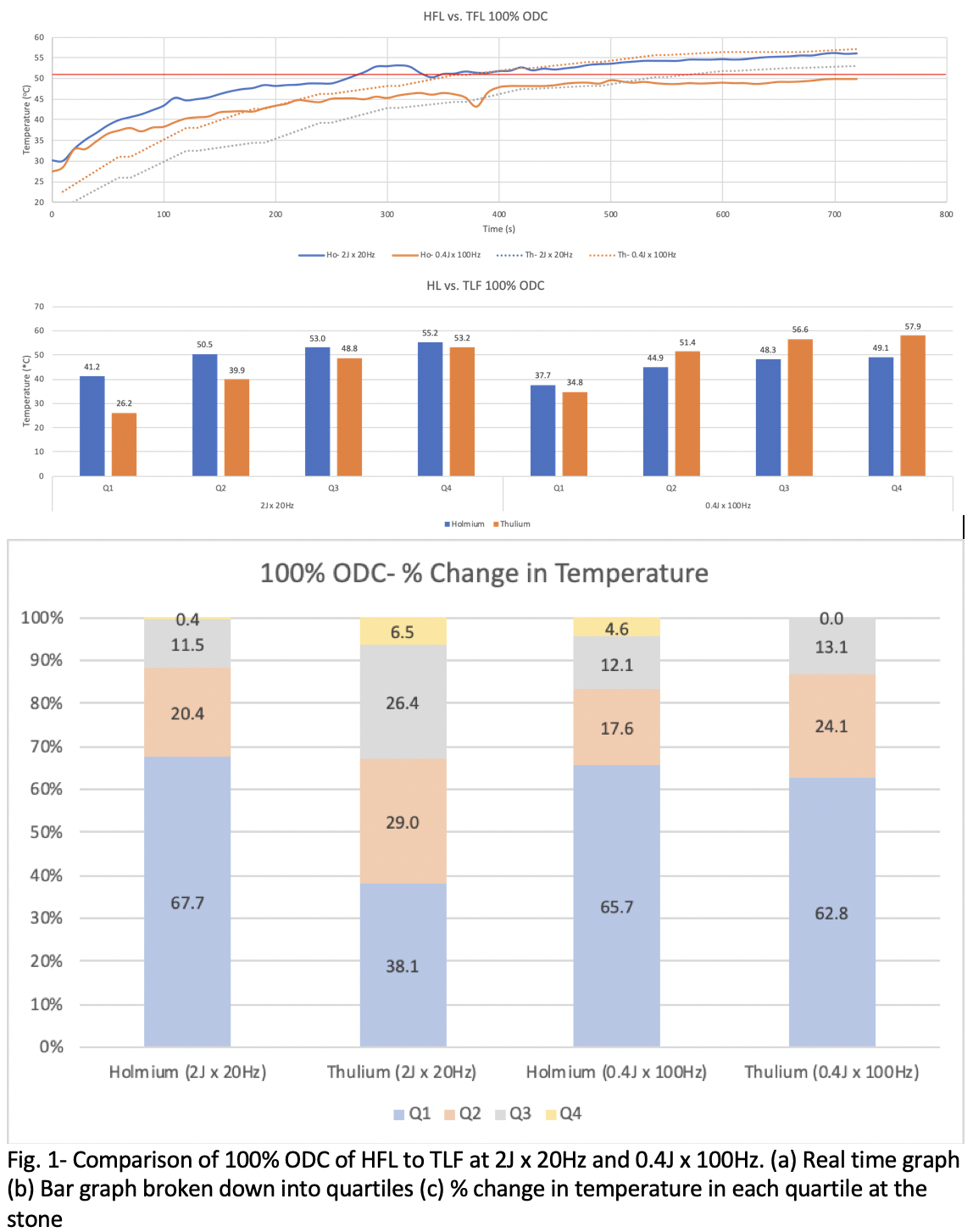
Introduction: Introduction of high-powered HL and TLF have raised the concerns of temperature generation during lithotripsy. In-vitro studies have yet to define the contributing factors in temperature profiles for these lasers. We sought to evaluate the thermal profiles for the HL and TLF in two 40w laser settings- fragmentation (2J x 20Hz) and dusting (0.4J x 100Hz). Each evaluated at 3 operator duty cycles (ODC); 50%, 75%, and 100% with different lasering on- and off- times (times on- 30s, 60s, 120s) in a realistic experimental setting Methods: In an anatomical hydrogel model of a human PCS validated with mechanical and computational fluid dynamics testing containing a 2cm pelvic BegoStone, lithotripsy using the Moses 2.0 and Soltive Premium (200um laser fiber, short pulse for both) via a flexible ureteroscope with standardized irrigation. Two laser settings were tested at 3 ODCs and 3 laser-on times. Temperature was recorded using a K-type thermocouple probes (Omega, Norwalk, CT). Statistical analysis was a non-linear regression in a third-order polynomial model (Prism 9) Results: 30 experiments were completed. At 100% ODC a significant difference in temperature profile was found comparing HL and TFL for each 40W setting (p < 0.0001). Higher temperatures were generated at 2J x 20Hz for HL vs 0.4J x 100Hz for TFL (Fig 1). For all ODCs and on/off iterations, TFL was hotter during dusting while HL was hotter during fragmentation except at 2J x 20Hz for 120s on (75% ODC) where TFL temp > HL. The rate of temperature increase for both lasers was greatest in Q1 after which temperature rise for HL plateaued compared to TLF which steadily increased (Fig 1b). Critical temperature (51oC) was reached for 2J x 20Hz at 100% ODC (HL at 280s, TFL at 550s) and both 75% ODC (60s on: HL at 540s, TFL at 750s) (120s on: HL at 580s, TFL at 880s). At 0.4J x 100Hz, only TFL reached critical temperature at 100% (at 300s) and 75% ODCs (60s on- at 510s, 120s on- at 430s). There was significant difference between HL and TFL for each cycle in 50% and 75% ODC (p < 0.0001) Conclusions: TFL generated higher temperatures during dusting vs HL during fragmentation that remained consistent for ODC and laser on iterations except during fragmentation with >60 sec laser-on times (TLF > HL). TLF heat generation occurs steadily vs HL generates heat initially during fragmentation SOURCE OF Funding: Internal Funding