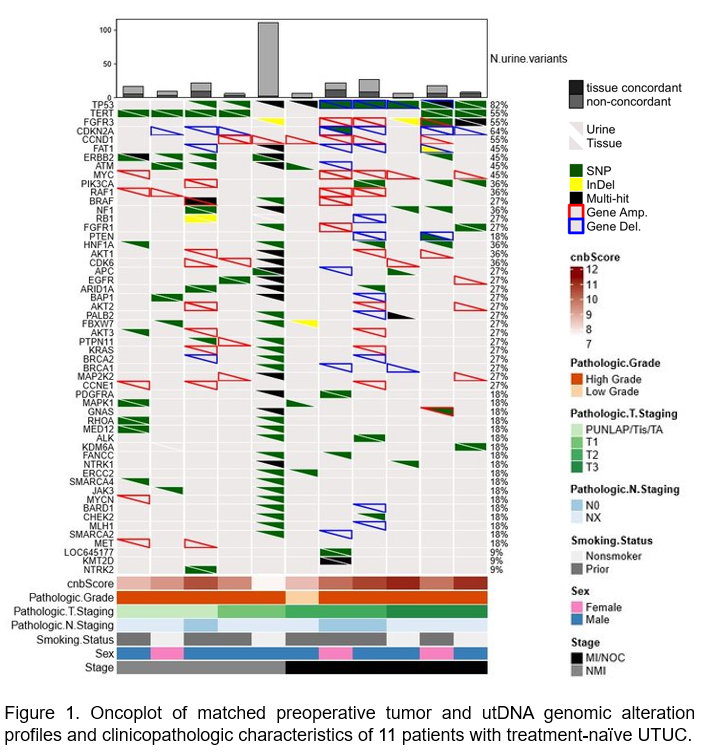
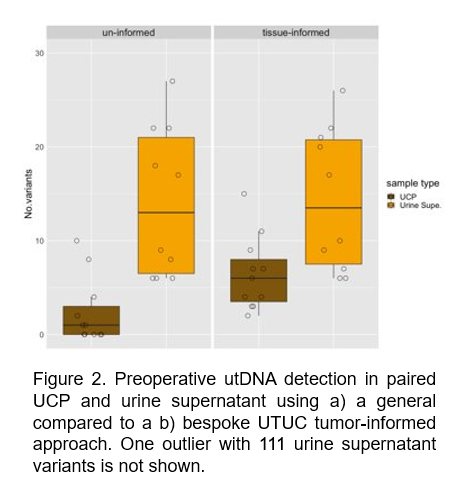
Introduction: Urine-based molecular biomarkers correlate with tumor variants in urothelial carcinoma of the bladder, showing promise for noninvasive detection of newly diagnosed tumors. However, the utility of next-generation sequencing (NGS) to detect urinary tumor DNA (utDNA) in upper tract urothelial carcinoma (UTUC) remains to be explored. Herein, we prospectively sequenced tumors and utDNA at the time of and serially after radical nephroureterectomy (RNU) to examine the feasibility of using utDNA in detection and surveillance of UTUC. Methods: Fourteen systemic therapy naïve patients with high-grade, clinically-localized UTUC undergoing RNU were prospectively accrued. Urine was collected preoperatively on the day of surgery and urinary supernatant and cell pellets (UCP) processed for extraction of utDNA. NGS used shallow whole-genome sequencing (WGS) to detect genome-wide copy number changes and a 152-pancancer panel (PredicineCARE) to profile single nucleotide variants, small insertions/deletions, and gene-level copy number changes. Variants with mutation allele frequency =0.25% in supernatant, =0.3% in UCP, and cancer hotspot variants >0.1% were reported. Results: Prior to RNU, utDNA variants were detected in 11/11 (100%) of urinary supernatants and 9/14 (64%) of UCPs using NGS. The most common alterations detected in the urine were in TP53 (81%), TERT promoter (55%), FGFR3 (55%), and ERBB2 (45%). More tumor variants were detected in urine supernatant than UCP (22.9 vs 2.4, p=0.004). Use of a bespoke tumor-informed approach to adjust MAF thresholds for calling variants increased utDNA detection by a mean 0.5 (range 0-3) variants in urinary supernatant and mean 2.3 (range 0-7) variants in UCP. There was no significant difference in the number of variants detected in urine of patients with UTUC staged as Conclusions: UTUC tumor variants are detectable in the urine of treatment-naïve patients undergoing RNU for UTUC using both a panel-based approach and WGS. utDNA detection and dynamics may present an opportunity for personalized monitoring of UTUC. SOURCE OF Funding: None