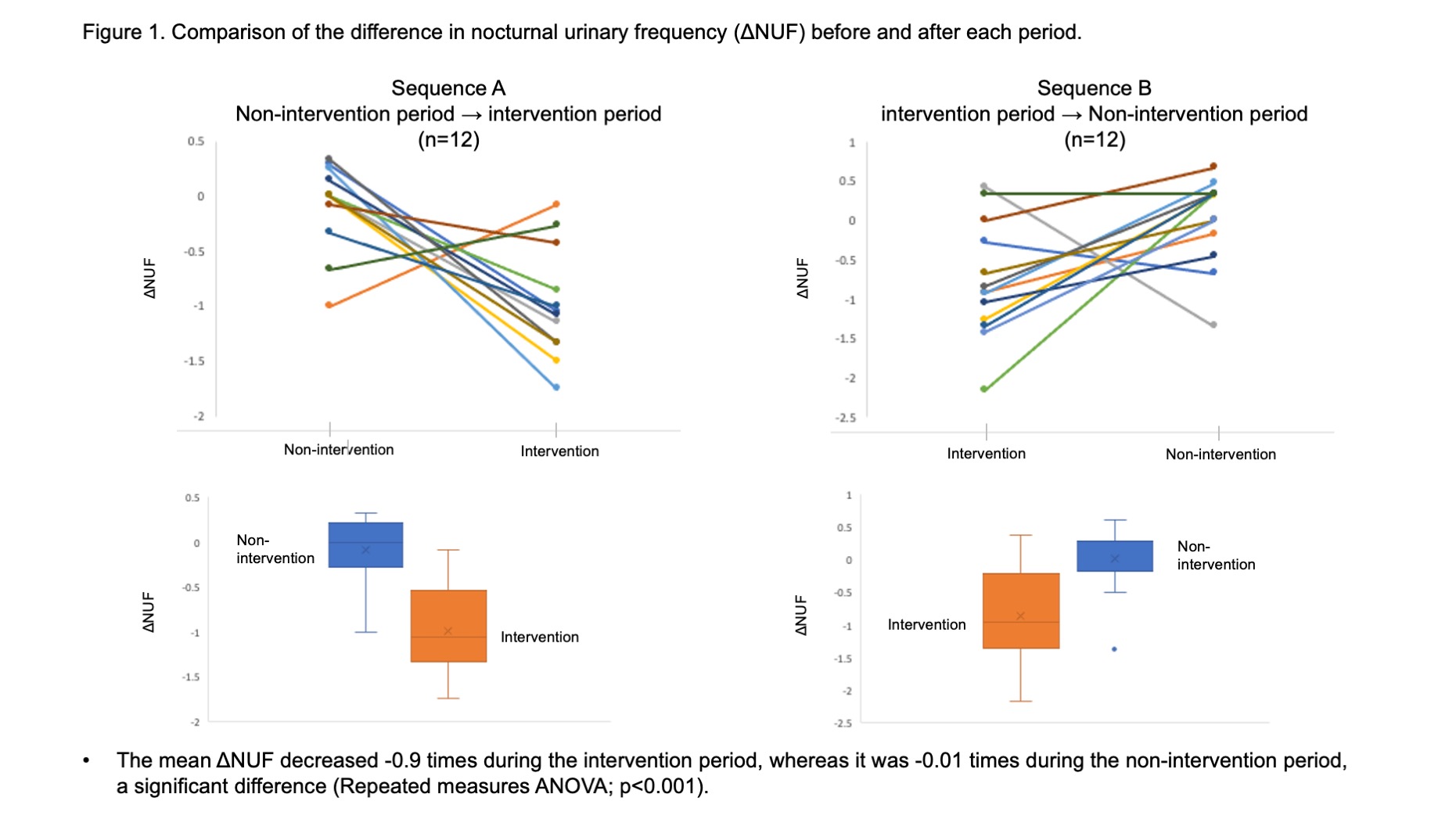
Introduction: Sleep disturbance is one of the main causes of nocturia. We examined whether nocturia could be improved by adhering to an appropriate bedtime determined by a wearable device that measures sleep-wake activity. Methods: Patients with nocturia examined at our institution and our associated hospital during the period March 2021–July 2022 for whom medical therapy was not indicated or not effective were enrolled. We conducted a prospective crossover comparative study with alternate 4-week intervention and non-intervention periods with a 2-week washout periods. During the intervention period, the participants were instructed to go to bed at a personalized bedtime determined by an Actiwatch Spectrum® (Philips Respironics). The optimal bedtime for each individual was calculated by the steepest descent method using the bedtime and mid-awake time obtained from Actiwatch. Frequency volume chart were administered before and after each period, and Pittsburgh sleep quality index (PSQI) were also administered before and after the intervention period. Results: Twenty-four patients (17 males, 7 females, mean±SD age: 79.8±5.7 years) were included. Their mean bedtime before the intervention was 21:31, and it became 22:08 after the intervention. The results showed that the mean nocturnal urinary frequency (NUF) decreased -0.9 (from 3.9±1.3 to 3.0±1.3) times during the intervention period, whereas it was -0.01 (from 3.71±1.2 to 3.70±1.1) times during the non-intervention period, a significant difference (p < 0.001). Before and after the intervention, the difference in NUF showed a significant negative correlation with the difference in bedtime (r=-0.59, p=0.002). The PSQI values also improved significantly from 7.6±2.9 to 5.4±3.2 (p=0.008). Conclusions: Patients with severe nocturia were observed to go to sleep inappropriately early. Correcting the bedtime may significantly reduce the frequency of nocturia and significantly improve the sleep quality of such patients. SOURCE OF Funding: None.