Session: MP61: Prostate Cancer: Localized: Surgical Therapy II
MP61-17: Prognostic Benefit of Neoadjuvant Chemohormonal Therapy Compared with Extended Pelvic Lymph Node Dissection in Patients with High-risk Prostate Cancer Treated with Robot assisted Radical Prostatectomy
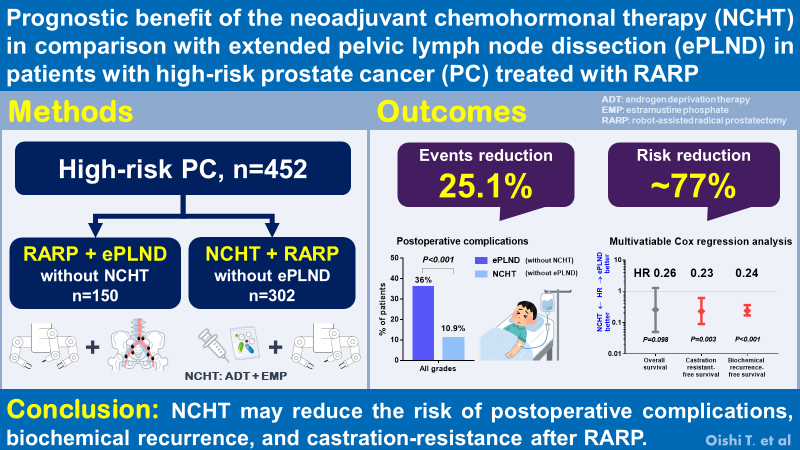
Introduction: We aimed to evaluate the impact of the robot-assisted radical prostatectomy (RARP) plus extended pelvic lymph node dissection (ePLND) on prognosis in comparison with neoadjuvant chemohormonal therapy (NCHT) without ePLND. Methods: We retrospectively evaluated 452 patients with high-risk prostate cancer (PC) defined as: any of PSA 20 ng/mL, Gleason score 8-10, or cT2c-3 who were treated with RARP between Jan. 2012 and Feb. 2021. Patients were divided into two groups: RARP with ePLND (ePLND group) and NCHT plus RARP without ePLND (NCHT group). We compared the complication rate (Clavien-Dindo classification), biochemical recurrence-free survival (BCR-FS), castration-resistant prostate cancer-free survival (CRPC-FS), and overall survival (OS) between the groups. Multivariable Cox regression analysis was performed to assess the impact of treatment on prognosis. Results: We identified 150 and 302 patients in the ePLND and NCHT groups, respectively. The postoperative complication rate was significantly higher in the ePLND group than that in the NCHT group (P < 0.001). BCR-FS, CRPC-FS, and OS were significantly longer in the NCHT group than those in the ePLND group. Multivariable Cox regression analyses showed that NCHT was significantly associated with the reduced risk of BCR (hazard ratio 0.24, P < 0.001) and CRPC progression (hazard ratio 0.23, P = 0.003), but not for OS (HR 0.26, P = 0.098). Conclusions: NCHT plus RARP without ePLND may reduce the risk of postoperative complications, BCR, and CRPC progression in comparison with ePLND during RARP. SOURCE OF Funding: none