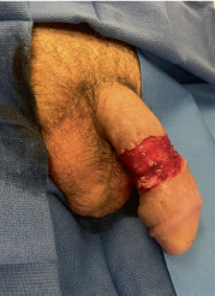
Introduction: Some studies have questioned subcoronal incision for IPP as a risk factor for glans ischemia or necrosis.1 We analyzed the largest ever reported series of IPP via subcoronal incision. Methods: We studied 898 men who had subcoronal IPP placement from 5/2015-3/2022 by single surgeon after ethical committee approval. 817 were first-time patients, with 81 revisions including 707 circumcised and 181 uncircumcised subjects. Most (76%) uncircumcised men underwent coincident circumcision; the remainder refused. Implants were Coloplast Titan (489) and AMS 700 (329) under local anesthesia in 329(36.6%) diabetics and 38(4%) Peyronie’s. We report postoperative occurrence of device infections and glans/penile skin problems. Results: Mean follow up was 47.3 months (3-81 months). Modeling (64%) and corporal relaxing incisions (36%) straightened the Peyronie’s patients. Transient distal penile skin edema which resolved within 2 to 4 months was noted in 673 cases (74.9%). Edema developed in 68.3% previously circumcised patients, 100% of concomitant circumcised patients and 96.2% of patients who had refused circumcision. One previously circumcised patient experienced prolonged edema of 7 months. Five previously circumcised patients (0.5%) developed partial distal penile skin necrosis on the proximal side of the subcoronal incision with all but one healing without grafting. (see below) The other patient sustained necrotic wound dehiscence which led to device infection and removal. There were zero cases of glans ischemia or necrosis. Only 2 patients became infected (0.2%). Conclusions: Subcoronal incision for simple IPP placement or revision is not an independent risk factor for glans ischemia or necrosis. Most postoperative patients do experience transient distal penile skin edema without glans involvement which heals without sequelae regardless of circumcision status. Very rarely (0.5%) penile skin loss may occur. 1. Wilson SK et. al. Glans Necrosis Following Penile Prosthesis Implantation: Prevention and Treatment Suggestions. Urology 2017; 107:144-148. SOURCE OF Funding: None