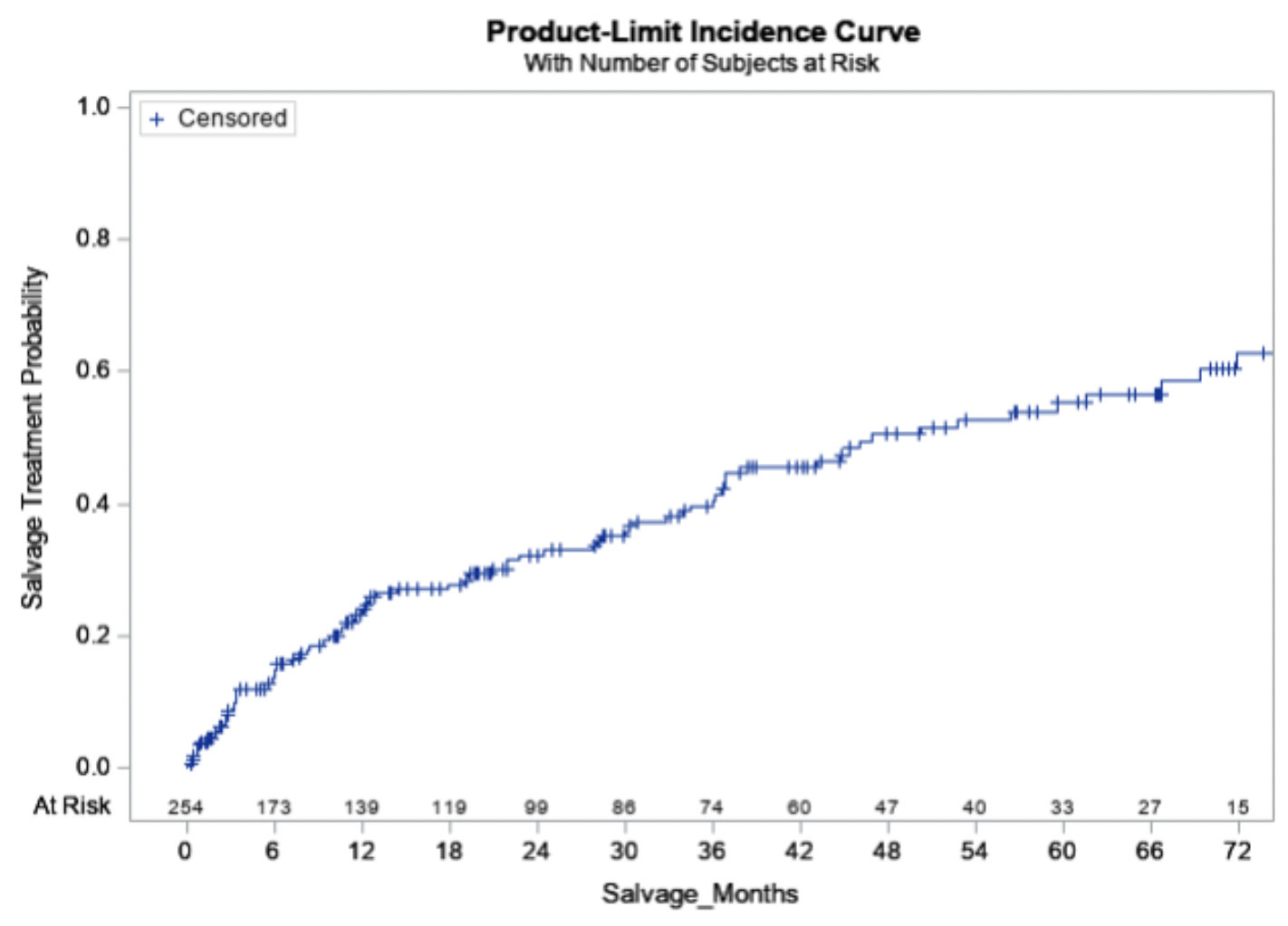
Introduction: We aim to evaluate rates of anticholinergic, beta-3 agonist or onabotulinum toxin-A (BTX-A) use among women who had sacral neuromodulation (SNM) placed for idiopathic overactive bladder (iOAB). Methods: Electronic health records were used to identify adult women who underwent stage II SNM for diagnosis of iOAB from 2012 to 2021. We excluded patients with prior BTX-A use (N=21) and those who did not follow-up after SNM placement (N=4). We queried for rates of anticholinergic, beta-3 agonist or onabotulinum toxin-A use following SNM placement (termed, salvage therapy). Kaplan-Meier methods were used to estimate event rates at 4 years and median time-to-salvage. Censoring occurred at the latest date among the following events: urology visit, OAB med prescription, botox intervention, or SNM removal. Results: Among 296 patients who tested SNM, 254 (86%) patients underwent stage II SNM placement and were included in the study, median follow-up time was 33.7 months. Of these, 83% were female with median age of 60 years (IQR 49-71). Among those who underwent SNM stage II, explantation rate was 25% (95% CI: 19 -34%) at 4 years with 43 patients having a recorded explantation. Of 254 patients, 91 patients had new prescriptions for anticholinergics (N=59) or beta-3 agonist (N=60) with 35.8% (95% CI: 36 – 72%) of patients with a prescription within 4 years. Of 254 patients, 24 underwent BTX-A with a proportion of 9.5% (95% CI: 7 – 19%) at 4 years after initial SNM II. Time to salvage treatment occurred at a median of 47 months (95% CI: 37 – 69mo) after SNM. (Figure). Conclusions: In our cohort, nearly a third of patients had new prescriptions for medical management for iOAB and 9.5% started BTX-A at 4 years following initial SNM II placement. SOURCE OF Funding: K12 -DK111011-06 UroEPI Career Development Program at the University of Michigan Department of Urology