Urologist University of Miami - Miller School of Medicine
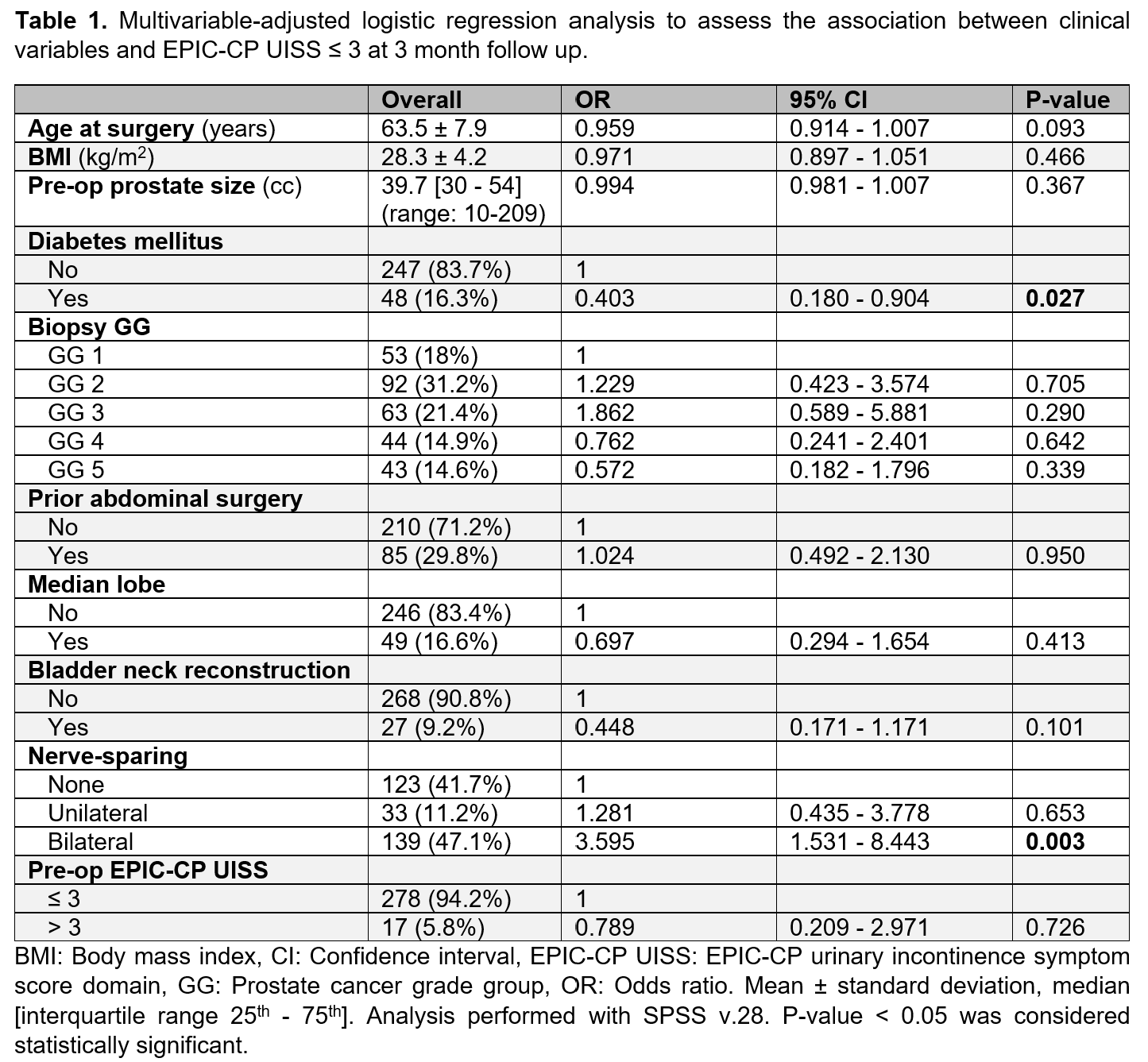
Introduction: A potential side effect following radical prostatectomy is urinary incontinence. Retzius-sparing robotic-assisted radical prostatectomy (RS-RARP) has been associated with improved urinary control outcomes. We investigated the impact of clinical variables and intraoperative surgical findings on recovery of urinary control following RS-RARP. Methods: Data was collected from a single-surgeon, single-institution prospective database of patients who underwent RS-RARP from May 2020 to July 2022 with = 3 months of follow up. Those without EPIC-CP (Expanded Prostate Cancer Index Composite for Clinical Practice) or unknown prostate size at baseline were excluded. Daily pad use and EPIC-CP urinary incontinence symptom score domain (EPIC-CP UISS) were used to assess continence status. Multivariable-adjusted logistic regression was performed to assess clinical variables associated with 3-month continence (EPIC-CP UISS = 3) following surgery. Results: A total of 295 men were analyzed, 49 (16.6%) had a median lobe (ML) confirmed intraoperatively, 27 (9.2%) required bladder neck reconstruction (BNR) using a tennis-racket suturing technique, and 139 (47.1%) had bilateral nerve-sparing (BNS). A total of 145 (49.2%) and 224 (76.6%) men reported using 0 or 0-1 pad per day = 1 week following catheter removal, respectively. At 3-month follow up, 65.4% and 86.1% of men reported using 0 or 0-1 pad per day, respectively; 81.7% of men had EPIC-CP UISS = 3. Approximately 90% and 97% of men reported using 0 or 0-1 pad per day 12 months following surgery, respectively. Diabetes mellitus (DM) was associated with worse continence (OR = 0.403, p = 0.027), and BNS was associated with better continence (OR = 3.595, p = 0.003) at 3 months. Prostate size, presence of a ML, and BNR were not associated with worse urinary control at 3 months (Table 1). Conclusions: Early continence rates after RS-RARP are encouraging with the majority of men being completely dry or using 0-1 pad per day within 1 week of catheter removal and by 3 months following surgery. DM has a negative impact and BNS has a positive impact on return of early continence. Age, prostate size, presence of ML, and BNR did not have a significant impact on early recovery of urinary control after RS-RARP. SOURCE OF Funding: No

.jpg "Dinno Francis Mendiola, MD photo")