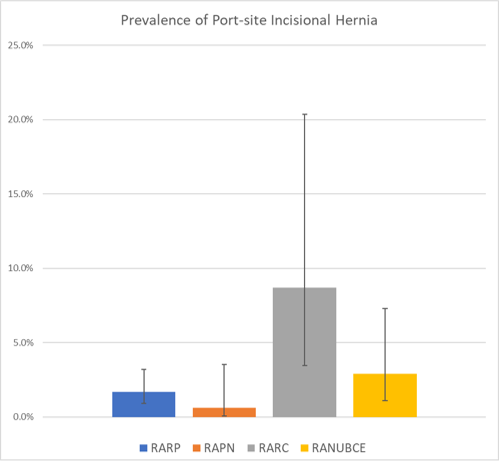
Introduction: Port-site incisional hernia is a rare but potentially dangerous complication following laparoscopic surgery. However, only sporadic studies reported this complication after robotic surgery. Therefore, this study investigates the prevalence of port-site incisional hernia after urologic robot-assisted laparoscopic surgery. Methods: This is a retrospective, single-center, observational study. Medical records were reviewed for 1295 patients who underwent urologic robot-assisted laparoscopic surgery from September 2013 to September 2021. The prevalence of port-site incisional hernia of robot-assisted radical prostatectomy (RARP), robot-assisted partial nephrectomy (RAPN), robot-assisted radical cystectomy (RARC), and robot-assisted radical nephroureterectomy with bladder cuff excision (RANUBCE) was computed. In addition, the association between uremic status and the post-operative port-site incisional hernia was shown with an odd ratio (OR) against a reference group. Results: Among 527 patients who underwent RARP, 9 patients suffered from port-site incisional hernia (1.71%; 95% CI: 0.90%, 3.22%), 1 out of 154 patients in RAPN (0.65%; 95% CI: 0.11%, 3.59%), 4 out of 46 patients in RARC (8.70%; 95% CI: 3.44%, 20.33%), and 4 out of 136 patients in RANUBCE (2.94%; 95% CI: 1.15%, 7.32%). For all 4 patients who suffered from port-site incisional hernia after undergoing RARC, their neobladders were constructed extracorporeally, of which 2 performed ileal conduit, Studer pouch in 1 patient, and another one underwent J-pouch construction. The average time to occurrence of port-site incisional hernia was 366 days and the longest time to occurrence was 1129 days. Most of the incisional hernia occurred at the camera port site (70.59%; 95% CI: 46.87%, 86.72%), and uremic status is associated with a higher tendency to suffer from port-site incisional hernia (OR= 3.68, p<0.05). Conclusions: RARC has a higher prevalence rate of port-site incisional hernia, among other types of urologic robot-assisted surgery. Incisional hernia tends to occur in RARC with extracorporeal neobladder construction. In addition, the port-site incisional hernia is associated with the larger port size and the uremic status of the patients. SOURCE OF Funding: no