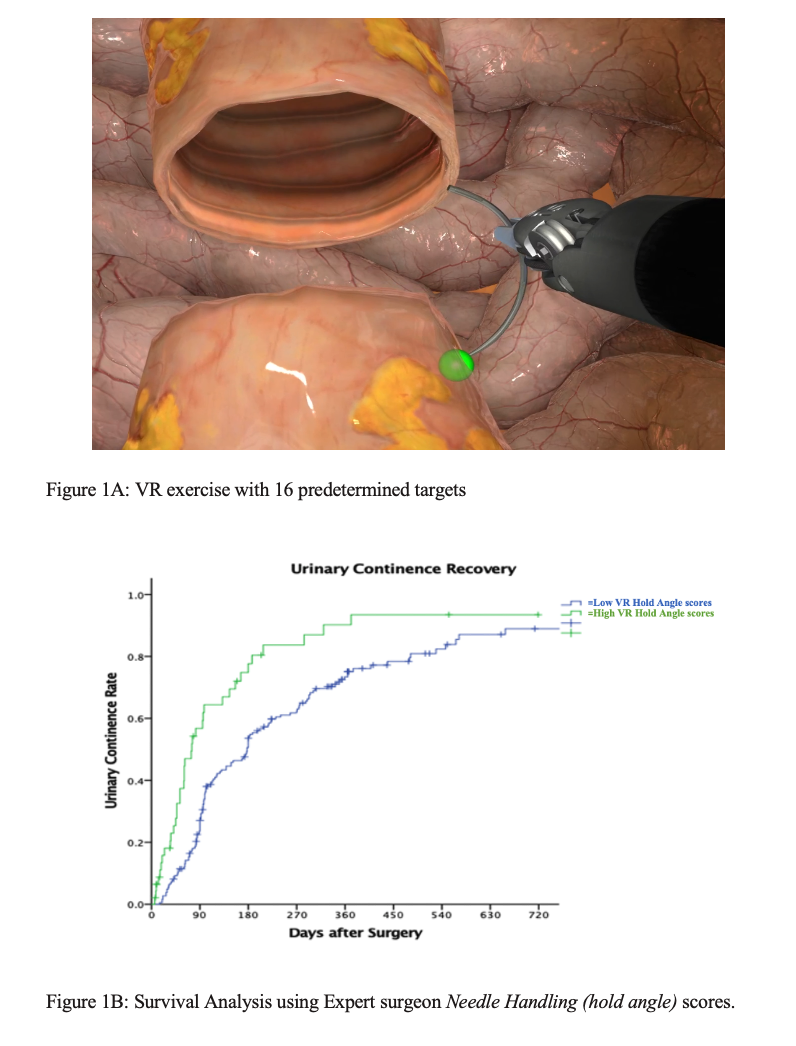
Introduction: Virtual reality (VR) provides a standardized setting for surgical skill assessment but currently lacks high-level multi-institutional evidence to validate the predictive value of VR. We have previously developed a granular suturing assessment tool (EASE), which can accurately distinguish surgeon experience in live surgery. This present study aims to further validate EASE in a VR environment and evaluate the utility of VR as a tool to predict clinical outcomes. Methods: 21 surgeons in this prospective five-center study completed VR simulation suturing exercises on the Surgical Science™ Flex VR simulator (Fig 1A). 5 independent and blinded graders received standardized training and provided technical skill assessment for VR using EASE. EASE was adapted to be relevant for a simulated environment (EASE-VR). Inter-rater reliability was measured using prevalence-adjusted bias-adjusted kappa (PABAK) with agreement >0.6 in all graded subskills. Expert (>100 robotic cases) and trainee ( <100 cases) scores were compared using generalized estimating equation. Correlations for expert surgeon EASE-VR scores and post-surgical clinical outcomes were calculated using Cox regression while controlling for patient factors (age, BMI, preoperative PSA, biopsy Gleason Score, pathological tumor stage). Results: 7 trainees (median caseload 60, range 0-80) and 14 expert surgeons (1500, range 275-3000) participated in this study. In VR, experts had significantly better Needle Handling (hold angle p=0.048) and Needle Driving (wrist rotation p=0.014) scores compared to trainees. There were no statistically significant differences in all other domains (p>0.05). For expert surgeons, Needle Driving (wrist rotation) was not significantly associated with urinary continence recovery. Expert Needle Handling (hold angle) scores were found to have a significant positive association with urinary continence recovery (Hazard Ratio 2.11, 95% Confidence Interval 1.44-3.09, p<0.001) (Fig 1B). Conclusions: EASE-VR can distinguish surgical experience in VR simulation exercises. Our results suggest that expert surgeon EASE-VR scores have positive association with post-surgical clinical outcomes. SOURCE OF Funding: Research reported in this publication was supported by the National Cancer Institute of the National Institutes of Health under Award Number R01CA251579. The content is solely the responsibility of the authors and does not necessarily represent the official views of the National Institutes of Health.