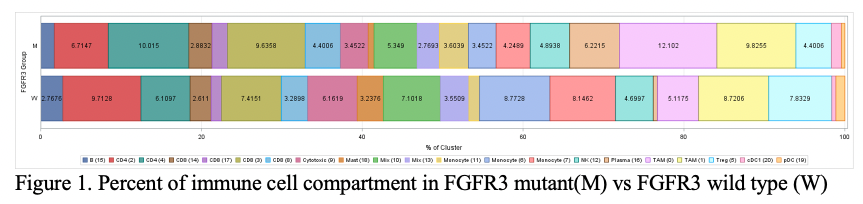
Introduction: FGFR3 is the most common mutation in UTUC. Tumors harboring FGFR3 mutations (FGFR3-M) have a T-cell impaired tumor microenvironment which may explain the poor response to immune checkpoint blockade. We performed scRNA-seq on 7 tumors to further characterize the T-cell immune phenotype of FGFR3-M tumors. Methods: scRNA-seq was performed on 7 UTUC tissue specimens from 7 patients who were treatment naïve using an established institutional process. We performed targeted gene sequencing on all samples to identify mutational calls. We assessed the phenotype of defined cell clusters and the immune composition of each sample according to known marker gene expression and SingleR prediction. Gene set enrichment analysis was performed over the differentially expressed genes with the Gene Ontology Biologic Process. Results: We identified 19 immune cell clusters (8 T-cell clusters) with unique biologic function (Figure 1). Within the CD4 compartment, FGFR3-M was enriched with exhausted/active CD4 cells characterized with Th17 cell differentiation/immune regulatory function (cluster 4) and yet with lower frequency of naive-like CD4 cells possessing alpha-beta T cell activation functions and lower T-cell receptor signaling (cluster 2). Regulatory T cells (cluster 5) were less frequently found in FGFR3-M tumors compared to their wild-type counterpart. In the CD8 compartment, FGFR3-M tumors had higher infiltration in cluster 3 which corresponds to a naïve state with lower exhausted/active markers, lower cytotoxic activity, leukocyte apoptotic process, and alpha-beta T cell differentiation regulation. There was also a lower proportion among cluster 9, a mixture of NK and CD8 cytotoxic cells, which is characterized by high cytotoxic activity, lower exhausted/active markers and response to interleukin (IL)-1, tumor necrosis factor (TNF), and NK cell chemotaxis Conclusions: FGFR3 mutated patients have a T-cell phenotype with more active/exhausted Th17-like CD4, lower Treg, and more CD8/cytotoxic cells in naïve state with lower response to IL-1 and TNF. scRNA-seq revealed enrichment of different functional states among T-cell compartments which may lead to improved therapeutic options in the future. SOURCE OF Funding: Department of Defense, The Thompson Family Foundation