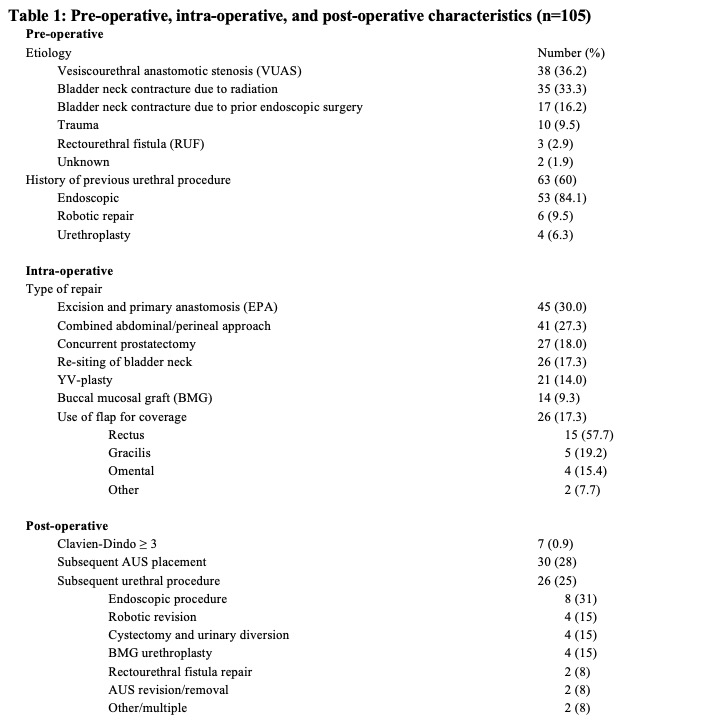
Introduction: Robotic posterior urethroplasty (RPU) has been described in small case series to be a viable option for men requiring posterior urethral reconstruction. Outcomes of RPU in larger scale cohorts are lacking. Herein we present our experience with RPU to date. Methods: We performed a retrospective review of men who underwent RPU from October 2014 to August 2022. Our cohort included men who required RPU secondary to conditions including prostate cancer treatment, pelvic trauma, and rectourethral fistulas. All RPUs were performed by a single reconstructive urologist at a single institution. We collected pre-operative, intra-operative, and post-operative characteristics. Post-operative complications were graded using the Clavien-Dindo classification system. Results: Cohort characteristics and outcomes are represented in Table 1. A total of 105 patients were included, with median age of 69 and median BMI of 27. 72 (68.6%) patients had a history of prostate cancer treated with surgery and/or radiation. 60 (57%) patients had a history of abdominal or pelvic radiation. Mean follow-up time was 18 months. 63 (60%) patients underwent a previous urethral procedure, 84.1% (53/63) of which was an endoscopic dilation. Intra-operatively, a combined abdominal/perineal approach was used in 41 (27%) patients. Various methods of reconstruction were implemented, the most common of which were excision and primary anastomosis (EPA), Y-V plasty of bladder neck, and re-siting of bladder neck. 7 patients had Clavien-Dindo grade 3a or higher complications within 30 days. 28% (30/105) subsequently required an artificial urinary sphincter (AUS) with average time from surgery to AUS placement of 9 months. One-quarter of patients required at least one subsequent urethral surgery for recurrent stricture, with 4 patients ultimately undergoing cystectomy and urinary diversion. All cystectomy patients had a history of radiation. Conclusions: We present one of the largest cohorts to date of patients who underwent RPU, demonstrating success of a variety of techniques for urethral reconstruction even in patients with history of failed urethral procedures. Immediate post-operative complications were rare, however 28% of patients did ultimately require AUS placement and 25% patients underwent a subsequent urethral procedure, most commonly via endoscopic approach. SOURCE OF Funding: None.