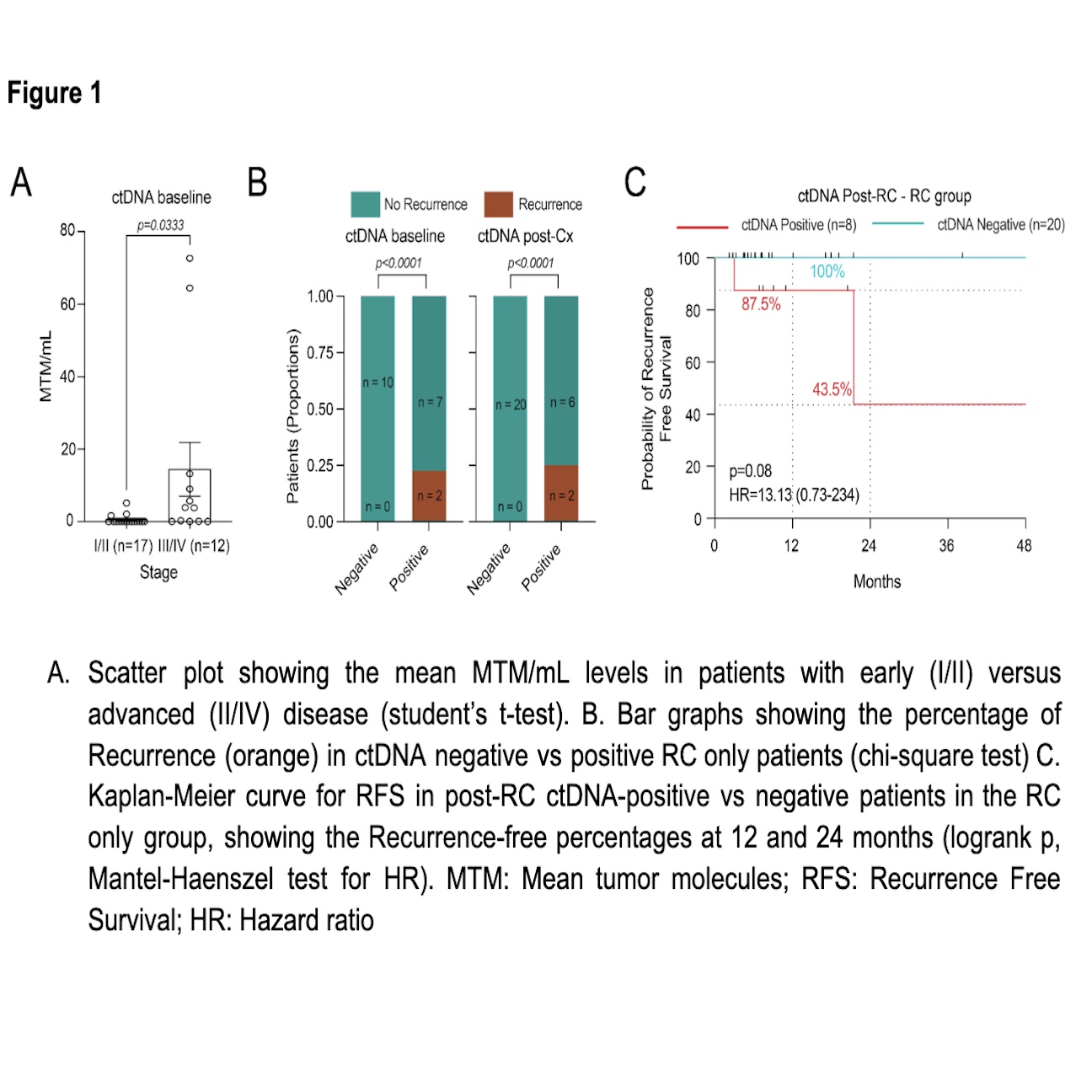
Introduction: Though radical cystectomy (RC) is the gold standard treatment for patients with muscle invasive bladder cancer (MIBC), ~50% of patients recur. Here, we aimed to elucidate the ability of circulating tumor DNA (ctDNA) as a prognostic biomarker to predict disease recurrence in patients who underwent RC. Methods: ctDNA analysis was retrospectively performed in a cohort of 49 MIBC patients with a median age of 70 years (range: 46-88 years) and 81.63% (40/49) male. In this cohort, patients were subjected to RC alone (RC group, N=38) or neoadjuvant chemotherapy (NAC) followed by RC (NAC+RC group, N=11). A total of 62 blood samples were collected from 11/18/21 to 09/21/22 for a median follow-up of 8.01 months (range: 2.23 - 63.76 months). ctDNA was analyzed prior to (N=26) and after RC (N=36) using a personalized, tumor-informed ctDNA assay (SignateraTM, mPCR - NGS assay); its association with clinical outcomes was assessed. Results: In this cohort, presurgical (baseline) mean MTM levels were significantly associated with advanced stage (III/IV) compared to early stage (I/II) disease, p=0.033 (Figure 1A). Among 26 and 36 patients with baseline and post-RC blood samples available, ctDNA detection rate was 34.6% (9/26) and 22.2% (8/36), respectively. ctDNA-positive patients were only observed in the RC group at both baseline (N=9) and post-RC (N=8). Clinical recurrence was observed in 22.2% (2/9) and 25% (2/8) of patients at the baseline and post-RC time points, respectively. Conversely, no recurrences were seen among the RC group who were ctDNA negative at both time points (NPV: 100%). Our data suggest that patients with ctDNA-positivity had a higher probability of recurrence (chi-square, p<0.001) (Figure 1B). On analyzing the association of ctDNA status post-RC with the survival benefit, ctDNA-positivity was associated with poorer recurrence free survival (RFS) (HR=13.13; 95%CI: 0.73 - 234, p=0.08) (Figure 1C). Conclusions: We report early results of presurgical (baseline) and post-RC ctDNA testing in patients with MIBC. ctDNA-negativity at both time points correlated with absence of disease recurrence. Further clinical evaluation with a longer follow-up is warranted to fully validate the role of baseline ctDNA in upfront clinical disease management. SOURCE OF Funding: None