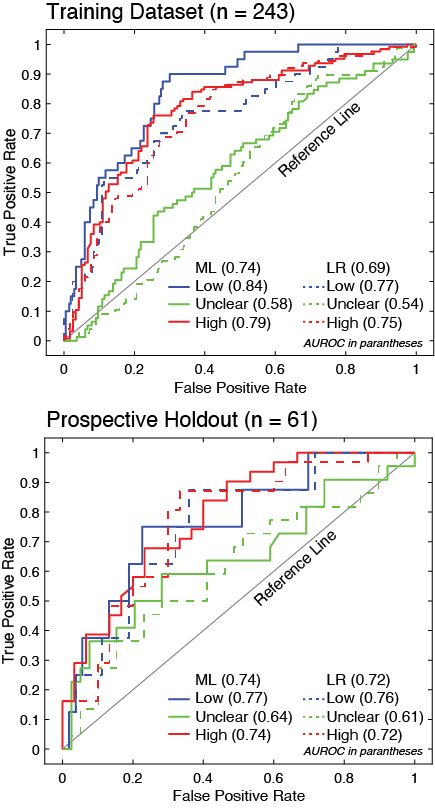
Introduction: For children with hydronephrosis (HN), the diuretic renogram is the gold standard in evaluating patients with suspected obstruction. Herein, we aimed to use routinely reported ultrasound findings, along with machine learning approaches, to predict the risk of ureteropelvic junction obstruction (UPJO) in infants with isolated HN. Methods: We included patients less than 24 months of age at baseline with a renogram within 3 months of an ultrasound. Age, sex, and routinely reported ultrasound findings (laterality, kidney length, anteroposterior diameter [APD], SFU grade) were abstracted. T 1/2 washout periods were collected from renography and stratified as low risk ( <20 minutes), unclear risk (20-60 minutes), and high risk of obstruction (>60 minutes). A random forest model was trained to classify obstruction risk, referred to as AI Evaluation of Renogram Obstruction (AERO). Model performance was determined by measuring area under the receiver-operator-characteristic curve (AUROC) and decision curve analysis. Results: A total of 304 patients met inclusion criteria, with a median age of diuretic renogram at 4 months (IQR 2, 7). Of all patients, 48 (16%) were low-risk, 102 (33%) were unclear risk, 156 (51%) were high risk of obstruction based on diuretic renogram. AERO achieved a multi-class AUROC of 0.75 which was superior to logistic regression (Figure 1). The most important features for prediction included age, APD, and SFU grade. We deployed our model in an easy-to-use application (https://sickkidsurology.shinyapps.io/AERO/). At a threshold cutoff of 30%, AERO would allow 137 more patients per 1000 to safely avoid a renogram without missing significant obstruction compared to a strategy in which a renogram is performed for all patients with SFU grade 3 or above. Conclusions: Routine ultrasound findings can be used to determine if a diuretic renogram can be safely avoided for children with isolated hydronephrosis, thus offering the potential to minimize invasiveness of monitoring and exposure to radiation. SOURCE OF Funding: None.