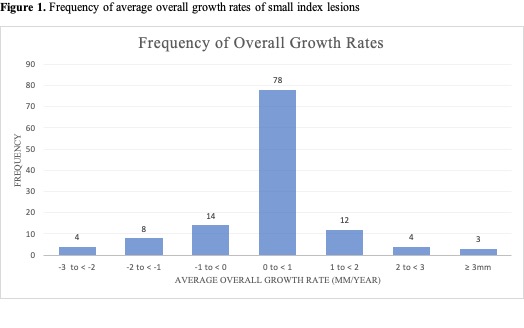
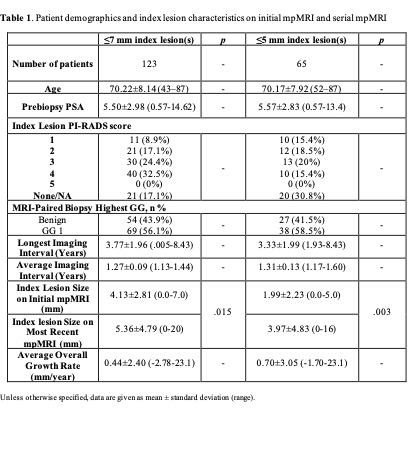
Introduction: Multiparametric magnetic resonance imaging (mpMRI) has demonstrated utility as an adjunct to active surveillance (AS). However, the optimal time interval between sequential MRIs is not standardized. This aims to analyze index lesion growth rates to potentially inform modern AS imaging practice. Methods: A prospectively maintained database of patients on AS at our institution was queried for patients with =2 mpMRIs with no index lesion or index lesions =7mm, as well as a subset of patients with no index lesion or index lesions =5mm. Both cohorts were limited to patients with paired MRI-targeted biopsy showing benign or Gleason grade group (GG) 1 disease. For MRIs preceding PI-RADS scoring, an internal Likert suspicion scoring system was converted into PI-RADS scores. Imaging intervals were calculated between serial mpMRIs and growth rate was calculated with two-tailed t-tests to assess differences between initial and most recent lesion sizes measured on mpMRI. Results: Between 2003-2021, patients on AS with =2 mpMRIs with small index lesions measuring =7 mm (n=123) or <5 mm (n=65) were identified (Table 1). Lesions in both the =7 mm (p=.015) and =5 mm (p=.003) cohorts demonstrated a significant change between first and last mpMRI. For the =7 mm cohort, average overall growth rate was 0.44±2.4 mm/year over a mean imaging interval of 1.27±0.09 years. For the =5 mm cohort, the average overall growth rate was 0.70±3.05 mm/year over a mean imaging interval of 1.31±0.13 years. There were 11 lesions that grew over 5 mm in the first year after initial mpMRI, however, univariate analysis of age, PSA, PI-RADS, and GG did not identify these variables as significant predictors of growth. The majority of lesions (84.6%) grew <1 mm/year (Figure 1). Conclusions: Small MRI lesions in patients on AS demonstrate minimal growth between follow up mpMRIs. This may indicate that these lesions can be followed longer surveillance intervals. Further studies are needed to prospectively identify the small subset of lesions that demonstrate more rapid growth. SOURCE OF Funding: N/A